
Voice-Activated Nurse Call for Non-Verbal Residents Using Eye-Gaze or AAC Devices
Can a Non-Verbal Resident Use a Voice-Activated Nurse Call?
For OTs, assistive technology specialists, and SLPs supporting residents with ALS, brainstem stroke, or advanced neuromuscular disease, one assumption keeps closing a door that does not need to be closed: that a voice-activated nurse call requires the resident's natural voice. It does not. If the resident already uses a speech-generating device that plays synthesized speech aloud, that device can trigger the call the same way natural speech would. This article walks through how that works, where it has already been documented in a real facility, and how to decide whether it fits a specific resident.
Key takeaways:
- Will-Call detects the activation phrase audibly — the source can be the resident's natural voice or a speech-generating device playing the phrase through its speaker
- A resident with ALS at a North Texas skilled nursing facility uses an Eyegaze Edge device to say "I need help," which Will-Call recognizes and uses to activate the facility's existing nurse call system, with no Bluetooth, Wi-Fi, or software pairing between the two devices
- Fit still depends on device speaker output, microphone placement, room acoustics, and the resident's ability to reliably access the activation phrase on their AAC device
- This is one option among several adaptive call methods, alongside Noddle, BT RemoteSwitch, autonoME, and traditional switches — the right choice depends on the resident, not the diagnosis
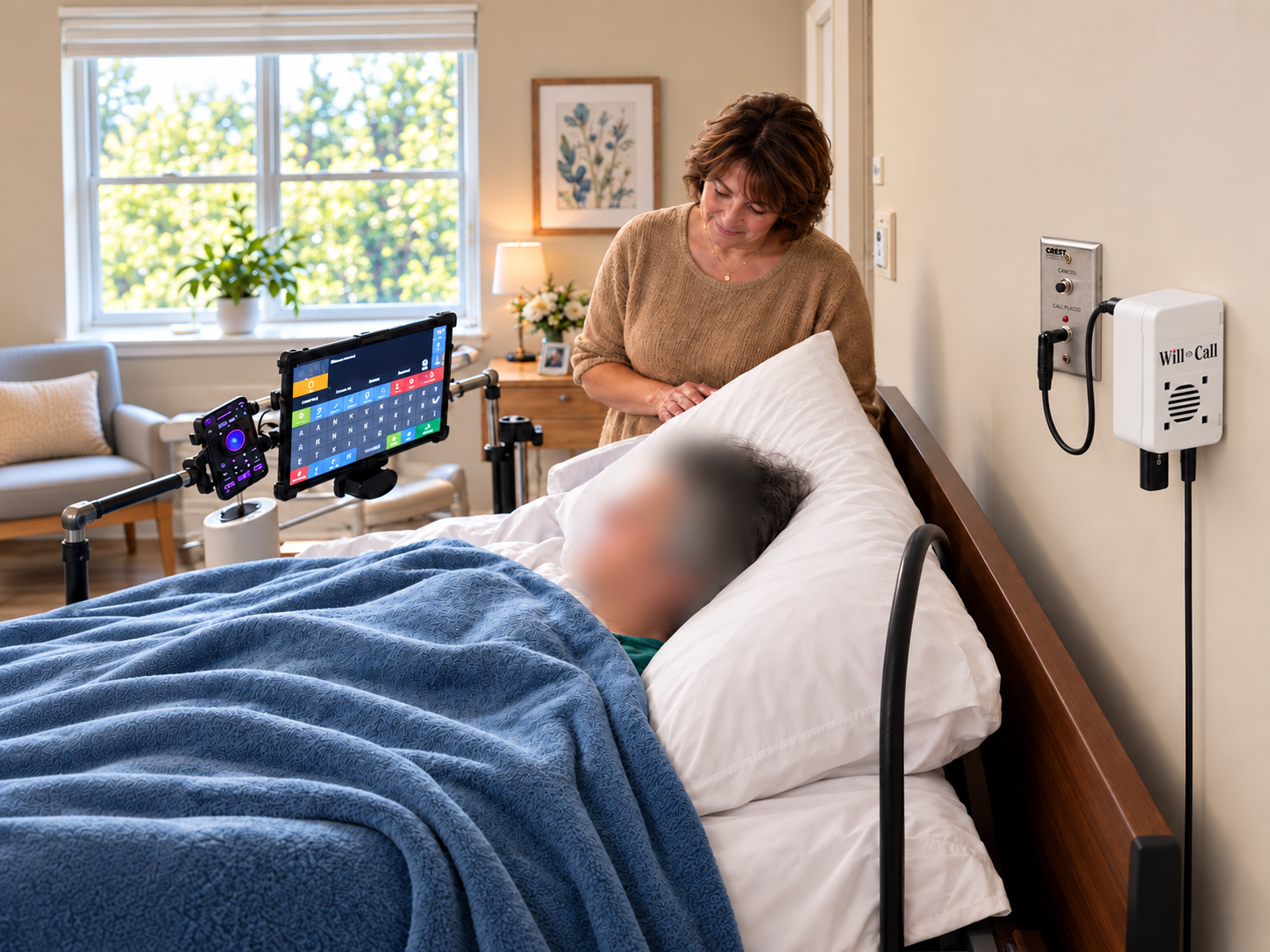
AAC speech-generating device producing the phrase "I need help" audibly, which Will-Call detects and uses to activate the existing nurse call system
The assumption that keeps non-verbal residents out of voice-activated call systems
Most OTs and AT specialists we speak with rule out voice-activated nurse call the moment a resident loses reliable natural speech. The logic seems sound: if the product listens for a phrase, and the resident cannot say the phrase, the product cannot help.
The assumption skips a step. Will-Call listens for the phrase to be heard, not for the resident's larynx to produce it. If any speaker in the room plays the phrase clearly enough for the microphone to pick up, the call goes through. That includes the speaker built into a speech-generating device.
This matters because AAC use in late-stage ALS and similar conditions is not rare. The ALS Association describes AAC as a standard part of care, noting that eye-gaze technology "allows individuals to control a communication device using eye movement" and that users can "select letters, words, and messages that are then spoken aloud by the device." AAC "may be used to supplement existing speech (augmentative communication) or serve as an alternative when speech is no longer functional (alternative communication)" (ALS Association).
The nurse-call gap for these residents is well-documented. An NIH-funded clinical trial at Iowa Adaptive Technologies exists specifically "to address the needs of the many patients who cannot access the standard nurse call systems," including those who "may not be able to speak due to mechanical ventilation." A peer-reviewed paper published in October 2025 frames nurse-call access for ALS as belonging to the AAC lineage, noting that in severe motor impairments, "voluntary limb movements — the primary means for intentional communication — are restricted, while oculomotor function is often relatively preserved."
The problem is recognized. What is less recognized is that a resident's existing AAC device may already be capable of solving it.
What happened at a North Texas skilled nursing facility
A resident with advanced ALS at a North Texas SNF had lost the ability to use standard call buttons and had also stopped being able to reliably operate breath-actuated switches. She remained cognitively intact and communicated with her care team through an Eyegaze Edge, a speech-generating device designed for long-term ALS use with accommodations for dry eyes, ptosis, and positioning needs specific to the disease.
Her sister made the initial contact about Will-Call. The setup that followed was unusual only in how ordinary it was: the resident's care team programmed the phrase "I need help" into her Eyegaze Edge. When she looked at the phrase, the device spoke it aloud through its built-in speaker. Will-Call, placed within microphone range, detected the phrase and activated the facility's existing nurse call system.
"It works perfectly with her eye-gaze machine. She can use her communication device to trigger a voice prompt, and it calls for help when needed."
— Caregiver, North Texas skilled nursing facility
There was no Bluetooth pairing. No app. No software integration between the Eyegaze Edge and Will-Call. No modification to the facility's existing nurse call infrastructure. The two devices did not know about each other. One produced sound. The other listened for sound. The resident's existing communication workflow — the one her SLP and family had already invested in — became the trigger.
Testing confirmed consistent activation across multiple attempts.
How an eye-gaze or AAC device triggers Will-Call
The mechanism is deliberately simple, which is why it works without special integration.
Step 1. The resident selects the pre-programmed phrase on their AAC device using whatever access method they already use — eye gaze, switch scanning, head tracking, direct touch.
Step 2. The AAC device speaks the phrase aloud through its built-in speaker, using the same synthesized voice output the resident uses for daily communication.
Step 3. Will-Call, placed within microphone range of the AAC device's speaker, detects the phrase and closes the same circuit that a physical call button would close. The nurse station sees the same signal it always sees. The call light behaves the way it always does.
Key point: The AAC device and Will-Call are not connected to each other. The audio traveling through the air between them is the only link. That is what makes this setup viable in a room without any facility-side changes.
If you want to see how Will-Call responds when the phrase is spoken, you can watch a short workflow demo. The response is the same whether the phrase comes from a natural voice or an AAC device speaker.
When this may work for your resident — and when it may not
The North Texas case is a real proof point, not a universal one. Whether Will-Call fits a specific resident with AAC depends on several factors the SLP and OT will already be familiar with.
Fit signals
- The resident already uses an AAC or speech-generating device with audible speaker output
- The device volume can be set high enough for clear pickup at typical microphone distances
- The resident can reliably access a programmed phrase on the device (consistent eye-gaze calibration, reliable switch access, or similar)
- The resident is cognitively intact enough to associate the phrase with a request for help and to initiate it when needed
- The room's ambient noise level allows reliable voice detection
Fit questions worth asking before you evaluate
- Does the AAC device stay powered and positioned during rest hours, or is it removed at night? A resident who cannot summon help while the device is off may need a separate access method for those hours.
- Does the AAC device sit close enough to Will-Call's microphone throughout the day, including during transfers and repositioning?
- Is the resident's eye-gaze calibration or switch access reliable at the times of day when they are most likely to need help?
These are the same questions the OHSU/University of Nebraska-Lincoln decision framework for AAC access in late-stage ALS already asks about any access method: "What muscles have consistent, reliable movements for placement of the switch? What switches are available that can be reliably activated with the residual movement?" Will-Call fits inside that framework rather than replacing it.
Other adaptive options to weigh alongside Will-Call
A voice-activated nurse call triggered through an AAC device is one option, not the option. Depending on the resident, other approaches may fit better:
- Iowa Adaptive Technologies' Noddle routes gesture, tongue click, or wink inputs to both the nurse call system and an SGD — useful when the resident has reliable non-verbal movement but the AAC device is not always accessible.
- ASI's BT RemoteSwitch, launched in 2025, pairs a Bluetooth adapter with a phone or tablet running TD Snap, Siri, or Google Voice Access, and takes 10 to 15 minutes to set up. It fits residents whose care setup already includes a dedicated phone or tablet as a switch host.
- ASI's autonoME combines an SGD with an environmental control unit and includes a caregiver call switch built in — a full-integration path for residents who need environmental control alongside nurse call.
- Traditional adaptive switches (pillow, tongue, sip-and-puff) remain the right choice for residents who do not use an AAC device or whose device does not produce audible speech output.
If a resident already uses an eye-gaze or AAC device with speaker output, Will-Call is worth evaluating because it adds a call-access path without adding hardware to the room or requiring the resident to learn a new access method. If the resident does not use AAC, one of the switch-based options above will likely fit better.
If you have a resident who might fit, a Test Drive is the fastest way to confirm it in the actual room with the actual device.
What to check before evaluating Will-Call with an AAC user
A short checklist for the OT, SLP, or AT specialist scoping the evaluation:
- Confirm the AAC device produces audible speech output through a built-in or external speaker (not headphone-only routing)
- Confirm the device volume can be set at a level the resident's care team will accept for continuous daytime use
- Confirm the phrase "I need help" can be programmed into a location on the AAC display the resident can reliably access
- Identify where Will-Call's microphone will sit relative to the AAC device speaker during typical positioning
- Confirm the facility's nurse call jack type at the bedside (Will-Call plugs into the same 1/4-inch jack a standard call button uses in most compatible systems, with adapters available for some others)
- Plan for reassessment in 60 to 90 days — AAC access needs in ALS change over time
- If the resident is at a stage where eye-gaze calibration, ptosis, or dry eyes affect device use, involve the SLP in the fit decision
The last point matters most. AAC access in late-stage ALS is a clinical decision made by an SLP and OT, not by a device vendor. Will-Call fits inside that decision. It does not replace it.
You can also read more Will-Call stories from residents with progressive conditions to see how other facilities have set up similar rooms.
Frequently asked questions
Does Will-Call work with Tobii Dynavox devices or other speech-generating devices besides the Eyegaze Edge?
The only AAC device Will-Call has confirmed in a real facility deployment is the Eyegaze Edge. Any speech-generating device that produces the activation phrase audibly through a speaker may work using the same mechanism, because Will-Call is listening for the phrase, not for a specific device signature. A Test Drive is the reliable way to confirm fit with a specific device before committing.
What if the resident's AAC device volume is too low for Will-Call to hear?
Microphone placement is the first adjustment. Will-Call ships with a standard microphone that typically picks up voices within three to eight feet in a quiet room, and an extended microphone is available for setups where the AAC device speaker sits farther from the base unit or where room noise is a factor. If device volume still cannot be raised to a workable level for the care team, this setup may not be the right fit.
Does using an AAC device to trigger Will-Call require Wi-Fi, Bluetooth, or pairing?
No. The AAC device and Will-Call are not connected to each other. The AAC device speaks the phrase aloud. Will-Call listens through its microphone and activates the nurse call. Nothing needs to be paired, installed, or configured between the two devices.
Can the same resident use Will-Call at night when their AAC device is off or repositioned?
If the AAC device is powered off or moved out of microphone range during rest hours, the AAC-to-Will-Call path will not work during those hours. This is a real limitation worth planning for, and it is part of why an OT or SLP should be involved in scoping the full 24-hour access plan, not just daytime coverage.
Who typically sets this up — the SLP, OT, family, or facility staff?
In the North Texas case, the family made initial contact and the facility care team handled bedside setup. In practice, the SLP or OT is usually the right person to program the activation phrase into the AAC device and confirm the resident can access it reliably. Facility maintenance or the person handling the nurse call jack connects Will-Call to the existing system. It is a small team effort, not a specialist install.
Next step
If you support a resident who uses an eye-gaze or AAC device with speaker output and you want to confirm whether Will-Call fits the room, request a Test Drive. Send a short description of the AAC device the resident uses, the facility's nurse call system, and the room setup. The team will help you figure out microphone placement and connector fit before anything ships.
Sources
- The ALS Association — Augmentative and Alternative Communication
- Eyegaze Inc. — Eye Gaze Solutions for ALS
- Electronics (MDPI) — Eyeglass-Type Switch: A Wearable Eye-Movement and Blink Switch for ALS Nurse Call
- ClinicalTrials.gov — Providing Access to an Alternative Nurse Call (NCT04393012)
- OHSU / University of Nebraska-Lincoln — Decision-Making for Access to AAC Technologies in Late Stage ALS