
What Real Will-Call Deployments Have in Common: Patterns From Facilities Using Voice-Activated Nurse Call
If you're an administrator, DON, or OT looking at Will-Call for the first time, the honest question isn't whether the product exists. It's whether it actually holds up in real facilities with real residents on the nurse call system you already have. This article looks at the patterns that show up across documented Will-Call deployments, so you can decide whether your facility fits.
Across the deployments documented on the Will-Call success stories page, the same shape keeps appearing: one resident who cannot reliably use the standard call button, a single person inside the facility who notices, a compatible existing nurse call system, and a setup that usually works after one or two practical adjustments. Not every facility fits the pattern. But when it fits, it tends to fit for recognizable reasons.
The one resident who started the conversation
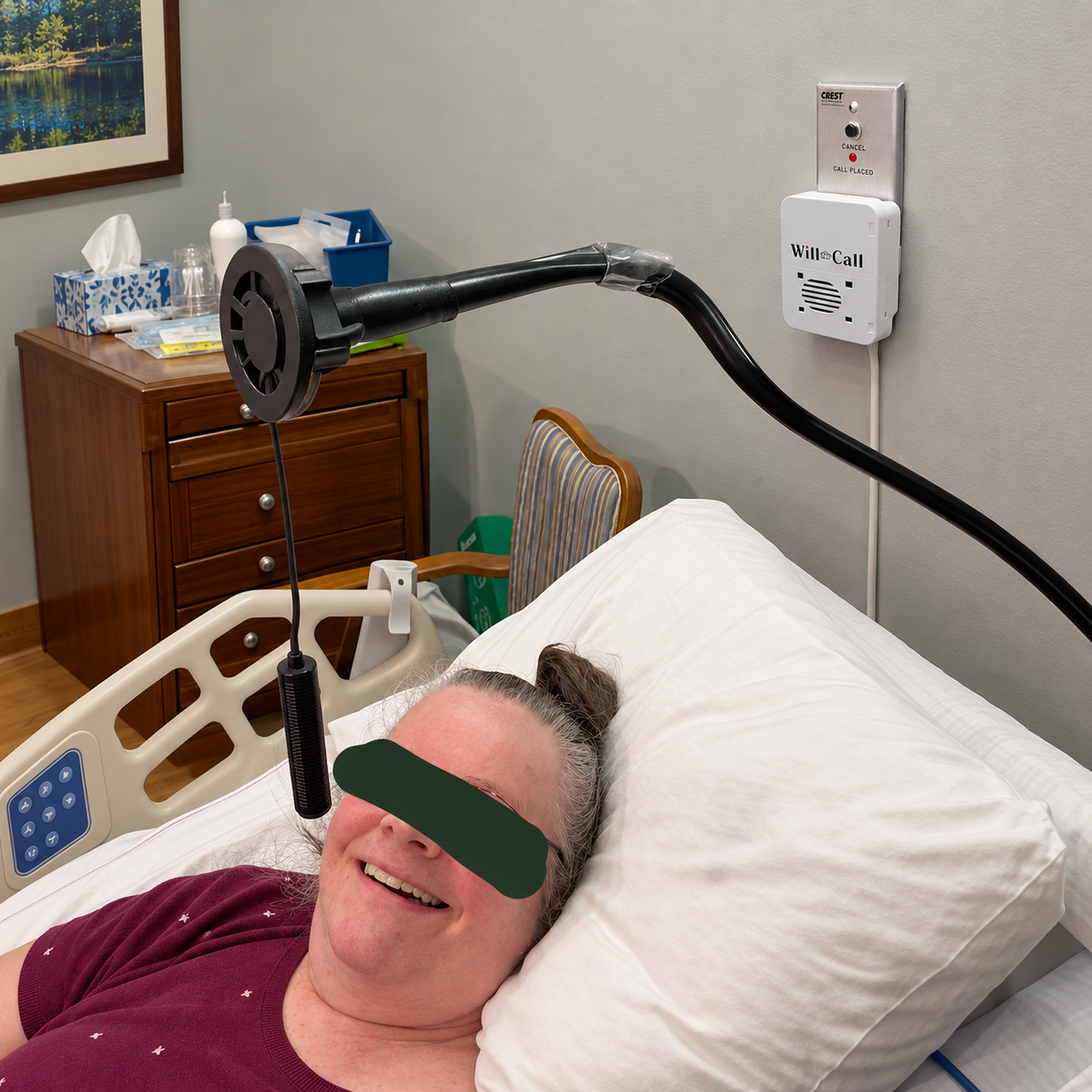
A real Will-Call setup at bedside. Microphone placement and nurse call panel connection are the two setup variables that matter most.
Almost no Will-Call deployment begins as a facility-wide initiative.
It begins with one resident.
An ALS resident at Maple Lawn Nursing & Rehabilitation. A veteran with advanced Parkinson's at William F. Green State Veterans Home. A resident with progressive MS at The Reserve at Richardson. A daughter watching her mother drop the call light again and again at Oak Hill Nursing Home.
The trigger is not a strategic assessment of adaptive technology. It's a specific person the current setup is not serving.
Key point: If you're waiting for a facility-wide reason to evaluate Will-Call, you may be waiting for the wrong signal. In existing deployments, the reason is usually one resident whose access problem has become impossible to work around.
This matters because it lowers the internal decision threshold. You're not deciding whether to change your nurse call infrastructure. You're deciding whether to try a voice-accessible option for a resident who already has an access barrier your team has already noticed.
The conditions we see repeatedly across facilities
There is no single diagnosis that predicts a Will-Call fit. What predicts fit is a functional pattern: the resident cannot reliably reach, grip, locate, or press the standard call button, and they can produce the activation phrase audibly (either with their own voice or through a speech-generating device).
That said, certain conditions show up across documented deployments more than others.
Progressive neuromuscular conditions
ALS, muscular dystrophy, and advanced MS appear repeatedly. In these cases, the resident often had a workable call-button setup at admission that stopped working as the disease progressed. Grip weakens. Range of motion narrows. Fine motor control fades.
At Maple Lawn Nursing & Rehabilitation, an ALS resident could no longer use the standard button. Staff initiated a Test Drive to see if voice activation could work in the resident's specific room and nurse call setup. (Read the full Maple Lawn ALS deployment story.)
For residents with Duchenne Muscular Dystrophy, severe hand dysfunction is well-documented in the clinical literature. A PubMed-indexed review of DMD access needs notes that hand-controlled interfaces often become unusable, and sip-or-puff interfaces are used more often than hand-controlled ones in this population. Voice activation has become a practical alternative in cases where the resident retains speech.
ALS with speech loss — including AAC users
This is the pattern most facilities don't expect: a resident with ALS who has lost natural speech is not automatically excluded from Will-Call.
At a skilled nursing facility in North Texas, a resident with advanced ALS used an Eyegaze Edge speech-generating device. Her sister made the initial contact. The resident programmed "I need help" into the device. When she looked at the phrase, the device spoke it aloud through its synthesized voice output. Will-Call recognized the phrase and activated the facility's existing nurse call system. No modifications. No Wi-Fi. No integration work.
"It works perfectly with her eye-gaze machine. She can use her communication device to trigger a voice prompt, and it calls for help when needed."
— Caregiver, North Texas SNF deployment
The ALS Association notes that AAC devices with speech output are commonly used in advanced ALS. What this deployment confirms is that a synthesized voice from an AAC device is a valid trigger path for Will-Call — the same as natural speech.
Fluctuating motor ability
Some residents can use the standard button on some days and not others. That variability is the whole problem, because the call system either works or it doesn't when the resident needs it.
At William F. Green State Veterans Home, a veteran with advanced Parkinson's could press the button on some days but not others. The care team had already tried pressure pads and sip-and-puff before landing on Will-Call. (Read the full William F. Green deployment story.)
Rare and less predictable conditions
Not every deployment involves a common diagnosis. At Oak Hill Nursing Home, a resident with a rare neurodegenerative disease kept dropping the call light and could not locate it once it fell. Her daughter pursued the Test Drive. The condition mattered less than the functional access gap.
Who inside the facility usually notices the problem first
The champion is rarely the same person twice. But the role pattern is consistent enough to describe.
The family advocate
A daughter, sister, spouse, or adult child who is at the bedside enough to see the access gap directly. They are often the ones who search for a solution online. The Oak Hill deployment and the North Texas SNF eye-gaze deployment both began this way.
The occupational therapist
The OT sees functional access as their professional lens. They notice that the button placement, the button type, or the resident's physical capability isn't matching. At Malley Transitional Care Center, an OT led the problem-solving process. Multiple button styles and placements were tested before Will-Call was evaluated as the option that fit. (Read the full Malley deployment story.)
The administrator or DON
When the champion is administrative, the trigger is usually a resident whose access issue has become visible enough to escalate. The CMS State Operations Manual, Appendix PP (F689) directs surveyors to "determine if the resident has the call system within reach and is able to use it if desired." A working call button in the room is not the same as an accessible call button for the specific resident. Administrators who have been through survey know this distinction.
At William F. Green State Veterans Home, the administrator became the champion after other adaptive methods failed.
Nursing staff on the floor
Sometimes the CNA or nurse who is in the room every shift is the one who names the problem. Skilled Nursing News has described the DON role as high-pressure and workflow-first — meaning tools that come to DONs from floor staff, tested and specific, tend to move faster than tools that arrive as vendor pitches.
What setup actually involves in real rooms
This is the section most product pages skip. The honest version:
Setup usually works. It also usually requires at least one adjustment.
Microphone placement matters
At The Reserve at Richardson, the resident had advanced MS and shared a room. The standard microphone position picked up ambient noise from the roommate's television. An extension microphone placed closer to the resident's bed resolved it. (Read the full Reserve at Richardson deployment story.)
The general rule that emerges across deployments: the microphone needs to be close enough to hear the resident's normal speaking voice, and far enough from competing audio sources (TV, roommate, hallway) to isolate it.
Adapters are sometimes needed
Nurse call systems come in different generations. A 1/4-inch plug fits many bedside jacks directly. Others need an adapter.
At Maple Lawn, the facility had a legacy Jeron nurse call system that required a custom adapter. At Dufferin Oaks in Ontario, a DIN8/Rauland-style environment required a simple cable adjustment. In both cases, the adapter was straightforward once the connector type was identified.
Setup principle: Compatibility should be checked for the specific room and system before ordering. A photo of the wall jack and existing call button, sent to the Will-Call team, is usually enough to identify the connector and any adapter needed.
Tone and phrasing take a small amount of practice
The trigger phrase is "I need help." The device works best when the resident pauses briefly, then says the phrase clearly at their normal speaking volume. Most residents learn the rhythm within a few practice attempts.
An honest checklist for evaluating setup
- Can the resident produce the phrase "I need help" clearly, either with their own voice or through an AAC device that plays it audibly?
- Is there a microphone placement in the room that captures the resident's voice without picking up competing audio?
- Do you know the connector type on your bedside nurse call jack, or can you send a photo?
- Are you willing to have a caregiver present for initial testing and a short practice period?
If most of these are yes, the setup pattern from documented deployments will likely apply.
The nurse call systems Will-Call has connected to in real deployments
Will-Call is designed to work with compatible existing nurse call systems. It is not designed to work with every system on the market.
Across documented deployments, Will-Call has connected to:
| System | Deployment example | Notes |
|---|---|---|
| Legacy Jeron | Maple Lawn Nursing & Rehabilitation | Custom adapter required |
| TekTone | William F. Green State Veterans Home | Standard connection |
| Rauland-style (DIN8) | Dufferin Oaks (Ontario) | Cable adjustment |
| Various standard 1/4-inch jack setups | The Reserve at Richardson, Malley Transitional Care Center, Oak Hill, North Texas SNF | Direct connection or extension |
If your facility uses one of the systems above, there is precedent. If your facility uses a different system, compatibility should be confirmed for the specific room and connector before ordering. The call system literature review from the National Library of Medicine confirms that call system access is a documented, recurring gap across nursing homes — meaning the underlying problem Will-Call addresses is not unique to any one system.
What administrators, DONs, and OTs consistently say about the decision
A few patterns come through in customer feedback across documented deployments.
On the fit for a specific resident: "We have this one resident who cannot use the regular call button properly." This is the sentence that starts most conversations.
On the setup experience: "Super easy to set up." Facilities repeatedly describe the connection process as straightforward once the connector is identified.
On the technical footprint: "No Wi-Fi dependency is a major plus." This one matters more than expected. Facilities that have been through Wi-Fi-dependent tech rollouts value the fact that Will-Call does not add another network dependency.
On the honest reality: "Besides that one issue, it's going great." The "one issue" is usually a setup adjustment — microphone placement, an adapter, a practice period. Not a fundamental failure.
Voice-accessible call support isn't a fit for every resident. Cognitive ability to retain the trigger phrase matters. Voice ability matters (or access to an AAC device that can produce the phrase). Room conditions matter. Will-Call is one option to consider based on resident fit, not a universal solution.
But when the fit is there, the pattern across facilities is consistent.
Is your facility seeing the same pattern?
The self-assessment is short:
- Do you have at least one resident who cannot reliably use the standard call button because of reach, grip, hand function, positioning, cognition, or dropped-device issues?
- Has someone on your team (family advocate, OT, DON, administrator, or floor nurse) named the problem out loud?
- Do you have a compatible existing nurse call system, or are you willing to share a photo to confirm compatibility?
- Can the resident produce the phrase "I need help" audibly, either directly or through an AAC device?
If the answer to most of these is yes, your facility is likely looking at the same pattern documented deployments have shown.
If this sounds familiar, request a 30-day Will-Call Test Drive. You can also read the full deployment stories referenced throughout this article.
FAQ
What kinds of facilities use voice-activated nurse call devices?
Documented Will-Call deployments include skilled nursing facilities, long-term care facilities, transitional care centers, veterans homes, and international long-term care settings. The common factor is a compatible existing nurse call system and at least one resident with an access barrier to the standard button.
Does a voice-activated call device work with older nurse call systems?
In some cases, yes. Will-Call has connected to legacy Jeron, TekTone, and Rauland-style DIN8 systems in documented deployments, sometimes with an adapter or cable adjustment. Compatibility should be checked for the specific room and connector before ordering.
How long does it take to know if Will-Call is working for a resident?
Most facilities that use the 30-day Test Drive know within the first week whether the setup works for the specific resident. Initial testing, microphone placement, and a short practice period usually happen in the first few days. Any needed adjustments (extension microphone, adapter, repositioning) are typically resolved shortly after.