
Voice-Activated Call Light for ALS: How an Eye-Gaze Communication System Restored Independent Access to Care
The Challenge
Amyotrophic Lateral Sclerosis (ALS) is a progressive neurological disease that gradually affects a person's ability to move, speak, and perform everyday tasks. While many individuals with ALS eventually rely on advanced communication technologies such as eye-gaze devices, access to nurse call systems often remains a significant challenge.
A resident living with advanced ALS at a North Texas skilled nursing facility had reached a point where she could no longer activate a traditional nurse call button. More recently, she had also lost the ability to use a breath-actuated switch.
Although she remained cognitively engaged and communicated effectively through an eye-gaze speech-generating device, she no longer had a reliable way to independently call for help.
How the Family Found Will-Call
The resident's sister learned about Will-Call through a contact in the assistive technology community and reached out to discuss whether the system might work with her sister's existing communication setup.
During the initial conversation, she explained that her sister relied on an eye-gaze communication device to generate speech through a computerized voice.
The question was simple:
Could that voice output activate a nurse call system?
Rather than immediately purchasing equipment, the family was invited to participate in the Will-Call 30-Day Test Drive Program to evaluate the solution in a real-world care environment.
Existing Technology
The resident used an eye-gaze communication system as her primary means of communication. By looking at words and phrases displayed on a screen, she could generate speech through a synthesized voice.
One of the phrases programmed into the device was: "I need help."
The goal of the evaluation was to determine whether that phrase could be used to activate the facility's existing nurse call system.
The Evaluation
One of the most notable aspects of the project was its simplicity.
The Will-Call unit was connected directly to the facility's existing nurse call infrastructure. No Wi-Fi, software integration, programming changes, or modifications to the communication device were required.
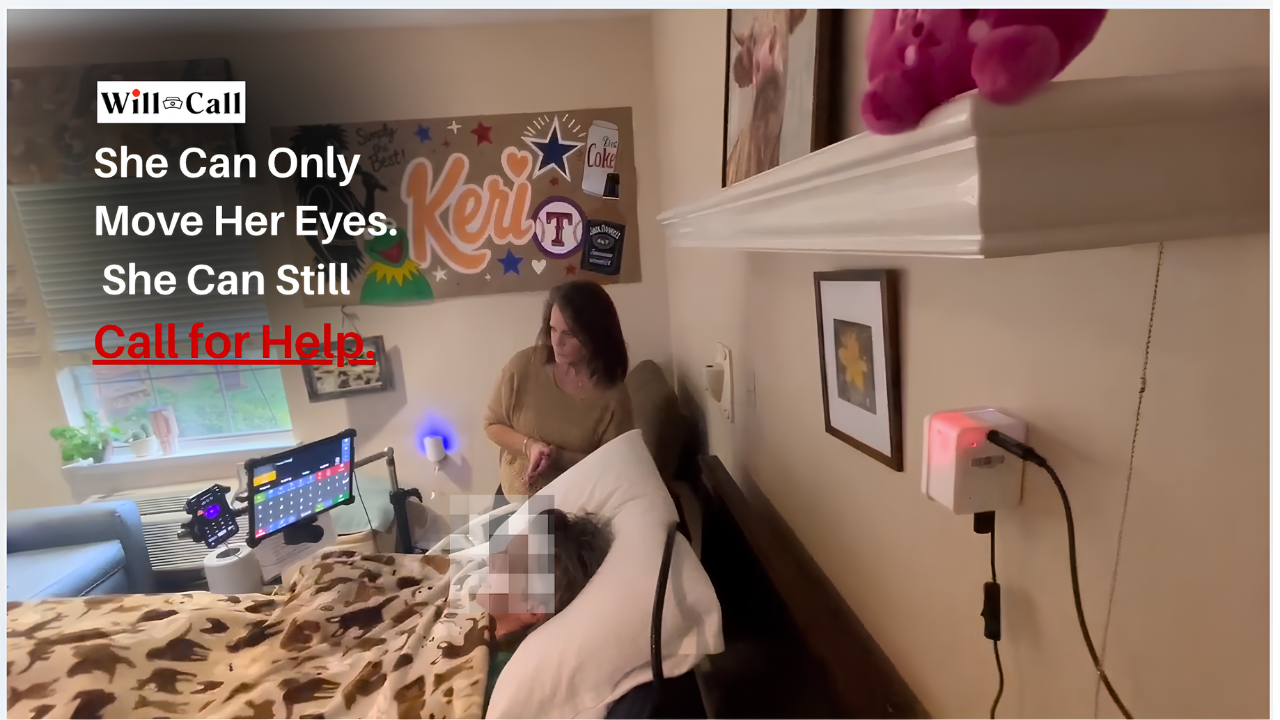
During testing, the resident navigated to the phrase "I need help" using only eye movements. When the eye-gaze device spoke the phrase through its computerized voice, Will-Call immediately recognized the command and activated the nurse call system. The test was repeated multiple times with consistent results. The communication device generated the phrase. Will-Call recognized the command and the nurse call system activated.
Family Perspective
According to the resident's sister, "My sister is no longer able to use her hands to press a button, and over the last few months she has also lost the ability to use a blow switch. We were at a loss on how she would call for help when she needed it.”
Watch the full testimonial here.
Following the evaluation, she shared:
“It works perfectly with her eye-gaze machine. She can use her communication device to trigger a voice prompt, and it calls for help when needed.”
Why This Matters
This case highlights an important challenge facing individuals living with ALS and other progressive neuromuscular conditions.
Communication technology has advanced dramatically over the last decade, allowing many individuals with severe physical limitations to continue expressing their needs. However, access to nurse call systems often remains dependent on physical controls that may eventually become unusable.
By combining an eye-gaze communication device with a voice-activated nurse call system, this resident was able to continue using technology she already relied upon every day while regaining independent access to caregiver assistance.
Looking Beyond ALS
Although this implementation involved ALS, the same approach may benefit individuals living with:
Spinal Muscular Atrophy (SMA)
Duchenne Muscular Dystrophy (DMD)
Quadriplegia
High cervical spinal cord injuries
Advanced Multiple Sclerosis
Other severe mobility impairments
For residents who can no longer operate traditional call buttons, the ability to leverage existing communication technology may provide a practical pathway to maintaining safety, independence, and dignity.
Conclusion
Through the Will-Call 30-Day Test Drive Program, a resident with advanced ALS successfully activated her facility's nurse call system using an existing eye-gaze communication device.
The solution required no modification to the communication platform, no changes to the facility's nurse call infrastructure, and no additional technology beyond the tools already being used for daily communication.
For families, clinicians, and long-term care providers supporting individuals with ALS, this case demonstrates how existing assistive technologies can work together to solve one of the most fundamental challenges in care: maintaining the ability to independently call for help.