
Call Button Alternatives for Residents With Parkinson's, Stroke, and Limited Mobility.
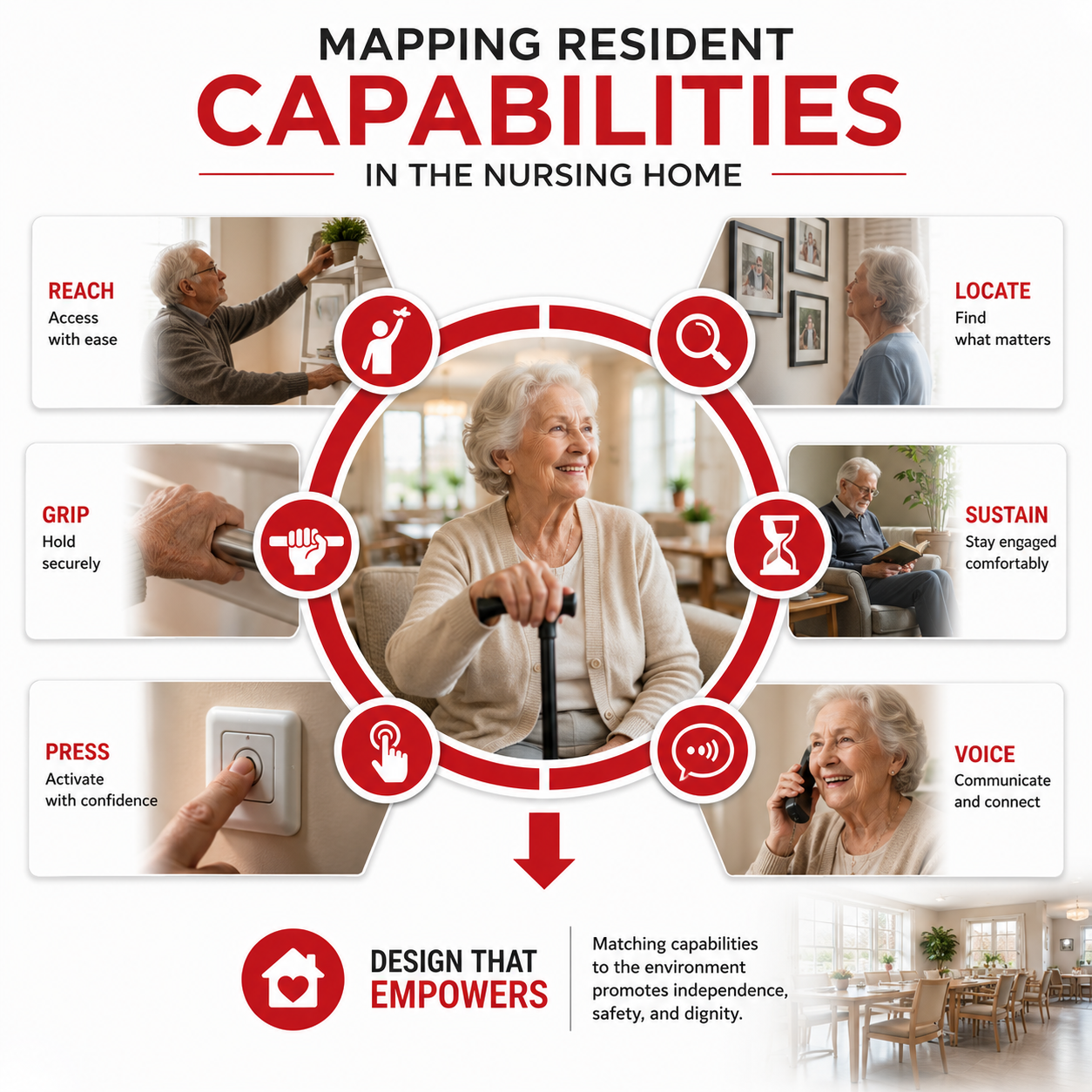
A capability-first view of adaptive call options. Match the option to the resident's reliable abilities, not the diagnosis.
A practical comparison for occupational therapists, directors of nursing, and rehab leaders evaluating adaptive call options for a specific resident whose standard call button is no longer working.
When a resident's abilities change, the call button often stops being a reliable way to summon help. The hard part is not finding adaptive products. The hard part is matching the right option to a specific resident whose abilities may vary across the day. This article compares the main adaptive call options and shows how to evaluate them by resident capability, not by diagnosis.
A 2020 scoping review on call light use in nursing homes found that residents with cognitive, motor, or sensory impairments are often unable to use standard call systems even when those systems are functioning correctly. The system works. The access does not.
The shortest answer: start with what the resident can reliably do, then choose the adaptive option that matches those abilities and the room. Pressure pads, soft switches, sip-and-puff, and voice-accessible call support each fit a different capability profile. None of them fit every resident.
Why the Standard Call Button Fails for Some Residents
A standard call button assumes the resident can locate it, reach it, grip or press it, and do so consistently. For many residents, one of those assumptions breaks before the others do.
The button is in the room. The wall jack works. Staff are responsive. But the resident still cannot use it.
"She could press the button with her thumb on some days, but not others. That variability was the whole problem."
— Care team observation, William F. Green State Veterans Home
Common patterns:
- The resident drops the call light and cannot locate it again.
- The pressure pad pinned to the pillow slips out of position.
- The button gets pressed accidentally throughout the day, but cannot be activated when help is actually needed.
- The resident can talk, but cannot reach the button on the bed rail.
- Hand function varies hour to hour, so a button that worked at 9 a.m. does not work at 3 p.m.
These are not edge cases. They are the daily reality OTs and DONs are working around.
Start With the Resident's Capabilities, Not the Diagnosis
Two residents with the same diagnosis can have very different access needs. A capability-first assessment is faster, more accurate, and easier to revisit when abilities change.
AOTA's practice framework positions occupational therapists as the right professionals to assess a person's reliable abilities across functional domains and recommend assistive technology based on those abilities. The assessment considers the person, the activity, and the environment, not the diagnosis alone.
The six-capability foundation used in the broader call access assessment covers reach, grip, press, locate, sustain, and voice. This article assumes that framework and builds on it: once you know which capabilities the resident can rely on, the question becomes which adaptive option fits those capabilities in this specific room.
Key point: The diagnosis informs the assessment. It does not determine the answer. A capability profile that holds across times of day is what determines the right option.
Adaptive Call Options to Evaluate
Each option below is appropriate for a specific capability profile. None of them is universally better. The honest comparison includes where each one fails.
Pressure Pads and Touch Pads
Pressure pads activate when the resident applies even light force to a flexible surface. They are useful when the resident can press but cannot reliably grip or hold a standard button.
Best fit: Residents who can move an arm, hand, head, or other body part toward a fixed location and apply light pressure consistently.
Where they fail:
- Pads slip out of position. A pad pinned to a pillow can shift when the resident is repositioned, and the resident may not be able to find it again.
- False activations happen when the resident rolls onto the pad in their sleep.
- A resident who cannot locate the pad cannot use it. Visual neglect or cognitive changes can make a pad invisible to the resident even when it is right there.
In one published example, a resident whose touch pad pinned to her pillow did not work reliably became a clear case for evaluating a different access method. The pad worked in theory. It did not survive the room.
Assessment notes: Test the pad in the actual sleeping position and in the actual chair. Watch what happens during a transfer. Confirm the resident can locate it without staff prompting.
Soft Switches and Sensitive Switches
Soft switches require less force than a standard button and can be mounted in flexible positions. They include large surface switches, ribbon switches, and lever switches.
Best fit: Residents with a reliable but limited movement, like a small finger flex, a head turn against a mounted switch, or a foot press.
Where they fail:
- Mounting matters. A switch in the wrong position is a switch the resident cannot reach when they need it.
- Some switches require more force than the product description suggests once positioned at an angle.
- Residents with progressive conditions may outgrow the switch as their reliable movement changes.
Assessment notes: Test in the position the resident will actually be in when calling for help. Confirm the movement is reliable across times of day, not just during the OT session.
Sip-and-Puff and Breath-Activated Switches
Sip-and-puff systems activate when the resident sips or puffs on a small tube. They are a long-standing option for residents with very limited movement but reliable breath control.
Best fit: Residents with high-level spinal cord injuries or other conditions that preserve breath control but limit voluntary movement.
Where they fail:
- The tube can become uncomfortable over long periods.
- Hygiene maintenance is ongoing.
- Residents with progressive respiratory weakness may lose the ability to activate the switch as the condition advances.
- Residents and families sometimes describe sip-and-puff as a method that works but is not ideal forever.
In one Canadian long-term care setting, a resident transitioned from a sip-and-puff system to a different access method when the sip-and-puff was no longer comfortable for daily use.
Assessment notes: Confirm respiratory reliability over a full day. Plan for the maintenance burden. Watch for skin or oral discomfort.
Voice-Accessible Call Support
Voice-accessible options let a resident activate a compatible nurse call system by speaking a short phrase instead of pressing a button. Will-Call is one example in this category.
Best fit: Residents who can speak a short phrase clearly and consistently across times of day, have the cognitive ability to remember and use the phrase, and are in a room with a compatible nurse call system and manageable ambient noise.
Where they fail:
- Voice changes affect reliability. Soft, breathy, or hoarse voice may not register consistently. Microphone placement and a sensitive extension microphone can help, but cannot fix a voice that the device cannot reliably hear.
- Cognitive changes affect the resident's ability to remember and use the phrase under stress.
- Ambient noise from a roommate, television, or hallway can interfere.
- Compatibility is room-specific. The nurse call system, connector type, and bedside layout all matter.
Fit criteria for voice-accessible call support include voice reliability across the day, cognition, room acoustics, and system compatibility. An OT assessment is the right starting point before recommending this category.
Important: Voice-accessible call support is not appropriate for residents with aphasia, significant dysarthria, or apraxia of speech. It is also not appropriate for residents whose voice is too soft to register consistently. Assess voice across multiple times of day, not just during the morning session.
Assessment notes: Test the phrase in the actual room, in the actual sleeping and seated positions, at multiple times of day. Watch the Will-Call workflow demo to see how activation works through an existing nurse call system.
Call Access Considerations for Parkinson's Disease
Parkinson's disease creates a specific challenge for call access that most adaptive technology guidance does not address directly: motor symptoms fluctuate predictably as medication wears on and off.
According to the Parkinson's Foundation, motor fluctuations and the "on-off" phenomenon are a defining feature of the condition as it progresses. During "on" periods, the resident may have relatively functional movement. During "off" periods, rigidity, bradykinesia, and tremor can significantly limit voluntary fine motor control, including the ability to press a button.
A resident who passes a call button test in the morning may not be able to press the same button in the afternoon. This is not inconsistent effort. It is the condition.
Voice is also affected. The Parkinson's Foundation reports that hypophonia, or soft and breathy voice, affects roughly 75 to 90 percent of people with Parkinson's at some point. A resident whose voice is consistently strong may benefit from voice-accessible support. A resident whose voice has weakened may not, even if cognition is intact.
What this means for adaptive call selection:
- Assess motor function during a typical "off" period, not just during peak medication effect.
- Assess voice strength at multiple times of day, including after meals and during fatigue.
- Plan for the condition to progress. The option that fits now may not fit in six months.
- Consider combining options if the resident has reliable voice during "on" periods and reliable motor control at a different time.
A veteran with advancing Parkinson's whose abilities changed day to day was assessed through several options before voice-accessible support was tested. The assessment took the fluctuation seriously. The choice followed the assessment, not the other way around.
Call Access Considerations for Stroke Survivors
"Stroke" is not a single profile. The right adaptive call option depends on which functions are affected and how.
According to the American Stroke Association, approximately one-third of stroke survivors experience aphasia, and additional survivors experience dysarthria or apraxia of speech. Most stroke survivors have some degree of one-sided weakness. Visual or sensory neglect can cause a resident to be unaware of objects on the affected side, including a call button placed there.
Practical implications:
- A call button on the affected side may be unreachable or, with neglect, effectively invisible. Reposition to the unaffected side.
- Voice-accessible options are not appropriate for residents with aphasia, significant dysarthria, or apraxia. The resident must be able to produce a specific short phrase clearly and consistently. An SLP consult is appropriate before recommending this category.
- A pressure pad or soft switch on the unaffected side often fits residents with hemiparesis and preserved speech and cognition, though voice-accessible support may also fit if speech is reliable.
The assessment for a stroke survivor should specifically address speech reliability, side-specific motor function, the presence of neglect, and cognitive capacity to learn and retain a new access method.
Questions to Ask Before Recommending an Adaptive Call Option
Use this list to structure the assessment conversation with the resident, family, nursing, and maintenance.
- What can the resident reliably do across a full day, not just during the assessment session?
- Has the option been tested in the actual room, in the actual sleeping and seated positions?
- If voice is being considered, has voice strength been assessed at multiple times of day?
- If a pad or switch is being considered, what happens during a transfer or repositioning?
- Can the resident locate the device independently after a nap or at night?
- What happens if the resident's abilities change in three months?
- Is the room's nurse call system compatible with the option, and has compatibility been confirmed for the specific connector?
- Who at the facility will be responsible for adjusting the setup if it stops working?
"We tried different button styles and placements before something worked. The first try was not the right one. That is normal."
The honest answer is that one assessment rarely produces a final answer. The first option often needs adjustment, and the option that fits today may need to be reevaluated as the resident's abilities change.
Frequently Asked Questions
Are there voice activated nurse call devices?
Yes. Voice-accessible call support is one category of adaptive call options. Will-Call is an example designed to activate a compatible existing nurse call system when the resident speaks a short phrase. Fit depends on voice reliability, cognition, room acoustics, and nurse call system compatibility.
How do you choose between sip-and-puff, a pressure pad, and voice activation?
Start with the resident's reliable abilities across a full day. Sip-and-puff fits residents with reliable breath control and very limited voluntary movement. Pressure pads fit residents who can apply light force consistently to a positioned surface. Voice-accessible support fits residents who can speak a short phrase clearly and consistently. None of these is universally best. The right option matches the capability profile.
Does the resident's diagnosis determine which adaptive call option is best?
No. The diagnosis informs the assessment but does not determine the answer. Two residents with Parkinson's, or two stroke survivors, can have very different access needs. Assess capabilities first.
Can a facility test an adaptive call option before purchasing?
Many adaptive options can be evaluated through trial programs or vendor demonstrations. For voice-accessible call support, Will-Call offers a 30-day test drive that lets a facility assess fit in the actual room before committing.
Who at the facility typically leads the call access assessment?
Occupational therapists are well positioned to lead the assessment because the methodology aligns with the AOTA practice framework. The DON, nursing staff, family, and maintenance all contribute. Maintenance involvement is important when compatibility with the existing nurse call system needs to be confirmed.
What happens if the resident's abilities change after a call option is set up?
Plan for reassessment. Progressive conditions like Parkinson's and ALS, and recovery trajectories after stroke, both mean the option that fits today may not fit in six months. Schedule a follow-up review and document the change triggers that should prompt earlier reassessment.
If you are evaluating call access for a specific resident and voice may be a reliable option, you can request a 30-day Will-Call Test Drive to assess fit in the actual room before committing to a purchase. You can also review other adaptive call setups that OTs, DONs, and family advocates have used.