
What Is a Voice-Activated Nurse Call Device?
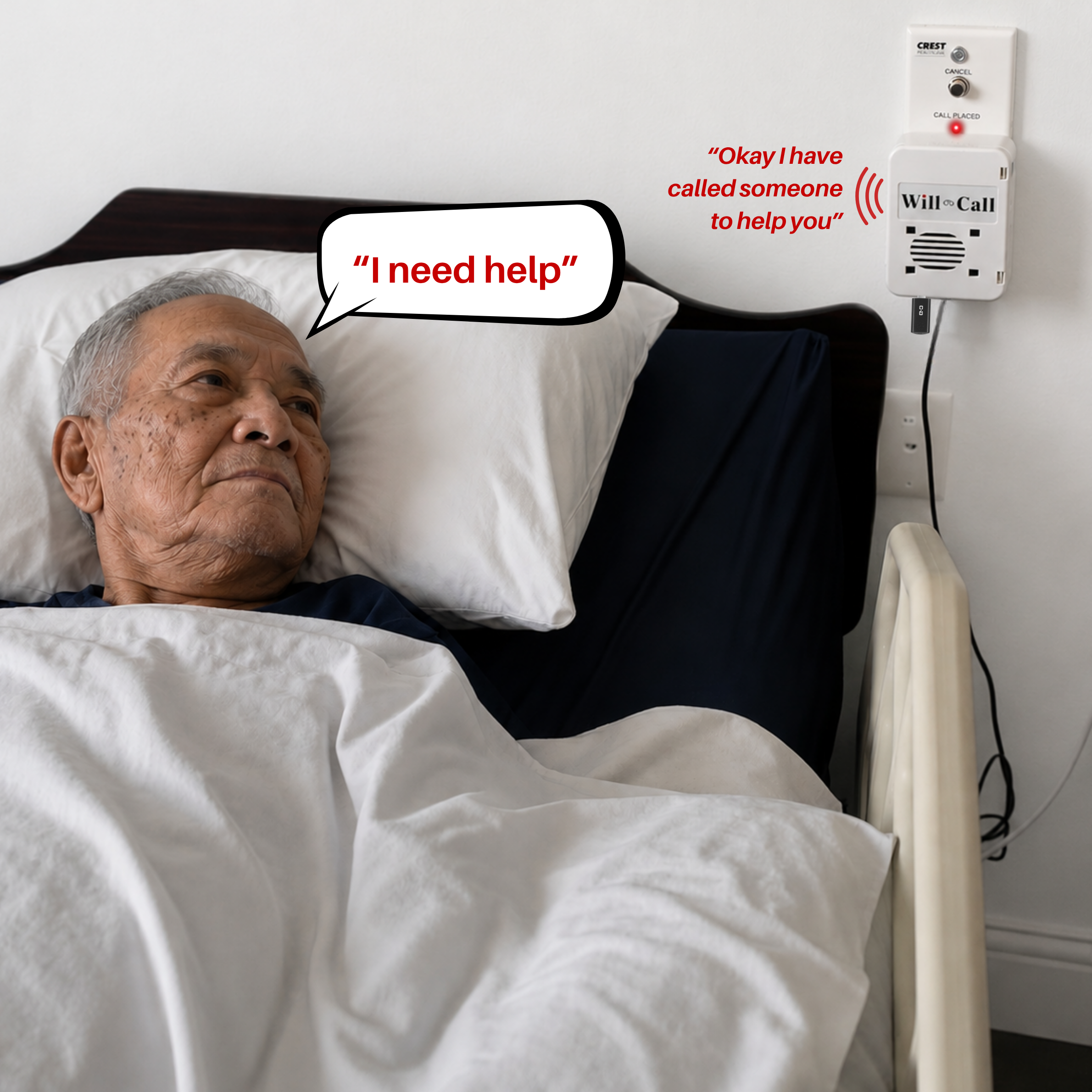
How a voice-activated nurse call device activates the existing nurse call system
This guide is for administrators, directors of nursing, and clinicians evaluating voice-activated nurse call options for a specific resident or for facility-readiness. It explains what the category is, how it works, who it is designed for, and how it behaves in a real resident room.
At a glance:
A voice-activated nurse call device is an accessory that listens for a specific activation phrase and then triggers a compatible existing nurse call system in the same way a standard call button would.
The device does not replace the nurse call system. It connects to it. When the resident says the activation phrase, the existing nurse call light, dome light, and panel response behave the way they always do. The difference is how the call is activated. Instead of pressing a button or pulling a cord, the resident uses their voice.
This category exists for one reason: some residents cannot reliably press, grip, locate, or hold the standard call button, even when the button is in the room.
How a Voice-Activated Nurse Call Device Works
The mechanics are simpler than most people expect.
A voice-activated nurse call device sits at the bedside, plugged into the same nurse call connection the standard call button or call cord uses. It runs a small program that listens only for a specific activation phrase. It is not transcribing speech, recording audio, or processing general conversation.
When the device hears the activation phrase, it electrically activates the nurse call pathway. The signal reaches the nurse call panel exactly as it would from a button press. The light comes on. The panel logs the call. Staff respond the way they normally do.
Most devices in this category also give the resident a spoken confirmation, so the resident knows the call went through. This matters more than it sounds. A resident who cannot press a button is also a resident who cannot see whether the light came on outside the room. Hearing "Okay, I've called someone to help you" closes the loop.
The activation flow looks like this:
- Resident speaks the activation phrase.
- The device detects the phrase and triggers the nurse call circuit.
- The existing nurse call system activates (light, panel, alert).
- The device gives a spoken confirmation back to the resident.
- Staff respond and clear the call at the panel, the way they always do.
No new alert pathway. No parallel notification system. No app for staff to monitor.
Who a Voice-Activated Nurse Call Device Is Designed For
A voice-activated nurse call device is appropriate for residents who can reliably speak the activation phrase but cannot reliably use the standard call button.
That is a narrower group than "residents with limited mobility." It is a specific access profile.
Residents who often fit:
- People with quadriplegia or high-level spinal cord injuries
- Residents with ALS, advanced MS, or Parkinson's, in stages where speech is still reliable but hand and arm function is limited
- Residents with Duchenne muscular dystrophy or similar progressive conditions
- Residents recovering from stroke who retain speech but have limited use of their dominant side
- Residents who consistently lose, drop, or cannot relocate the standard call cord
Residents who may not fit, or may need reassessment over time:
- Residents with significant cognitive impairment who cannot retain or use a specific activation phrase
- Residents whose voice has become very soft or whose speech has changed in ways that affect reliable activation
- Residents in progressive disease stages where voice may be affected (advanced ALS, post-stroke aphasia, advanced Parkinson's with hypophonia)
For residents with progressive conditions, suitability can change. A device that works well at one stage may need to be reassessed later. This is part of the care plan, not a flaw in the technology.
The most useful question to ask is not "does this resident have limited mobility." It is "can this resident reliably speak a short phrase when they need help, and can they not reliably use the standard call button?"
How It Fits With the Existing Nurse Call System
A voice-activated nurse call device is an accessory, not a replacement.
The facility's nurse call system stays in place. The wiring, panels, dome lights, and reporting all continue to work. The standard call button or call cord can usually stay in the room as a secondary option for staff or visitors.
The device plugs into the existing nurse call pathway, typically through the same connection the standard call button uses. Depending on the nurse call system, this connection may be a 1/4-inch jack, an 8-pin DIN, or a manufacturer-specific connector. Compatibility depends on the system, the room setup, and sometimes the specific call station.
Common compatible systems include Rauland Responder, TekTone, Jeron, Intercall, and West-Com setups. Some installations need a short adapter or extension cable to fit the room. For more detail on the connection itself, see how Will-Call plugs into an existing nurse call system.
This matters for two reasons.
First, the facility does not have to change anything about how it answers calls. Staff workflow, panel monitoring, and response routing all stay the same.
Second, compatibility should be confirmed for the specific room before ordering. The fastest way to do this is a photo of the wall jack and call station, plus the nurse call system make and model.
How It Handles Room Noise Like TV and Conversation
This is a fair question, and one of the most common ones from administrators and DONs.
A resident room is not a quiet room. The TV is often on. Roommates have visitors. Staff have conversations in the hallway and at the doorway. A device that activates a nurse call cannot treat every voice in the room as a signal.
A voice-activated nurse call device is designed to listen for a specific activation phrase, not general speech. It is not transcribing the room. It is waiting for one pattern. That design choice is the first part of how the category handles background noise.
The second part is microphone placement.
In practice, microphone placement is the lever that makes a real room work. The technical guidance is consistent across setups: place the microphone close to the resident, oriented toward them, and away from the TV or other sound sources. Standard microphones generally work within a few feet of a normal speaking voice. Extended microphones are used when the resident has a softer voice or when the room layout requires the microphone to be positioned closer to the pillow or bedside.
Honest framing matters here. No voice-activation system can guarantee that a television playing dialogue or a visitor speaking nearby will never produce an unintended trigger. What it can do is listen only for a specific phrase, and let the facility position the microphone so the resident's voice is the clearest sound the device hears.
For most rooms, this is a setup decision, not a product limitation. Test Drive programs exist partly so the facility can confirm the device performs the way it needs to in the specific room, with the actual TV, layout, and roommate situation.
How It Is Different From a Smart Speaker
A voice-activated nurse call device is not a smart speaker, even though both respond to voice.
A smart speaker (Alexa, Google Home, similar) is built for general consumer use. It connects to the internet, processes a wide range of speech, runs on a cloud account, and offers a long list of functions. It is not designed to integrate with a nurse call system. Routing it to activate a call light would require workarounds, smart-home automations, and a network connection that most facilities cannot or will not maintain in resident rooms.
A voice-activated nurse call device is built for one job: listening for a specific activation phrase and triggering a compatible existing nurse call system.
Practical differences that matter to a facility:
- It does not require Wi-Fi, Bluetooth, or an app for normal use.
- It does not have a cloud account, user login, or subscription.
- It is not designed to collect, store, or transmit protected health information.
- It does not add a new alert pathway. The nurse call system stays the source of truth.
- It plugs into the existing nurse call jack, not into a smart-home platform.
This is the cleanest way to evaluate the category. If a product needs Wi-Fi, an app, or a smart-home account to activate the nurse call system, it belongs in a different category and carries different IT, security, and workflow considerations.
Where Will-Call Fits in This Category
Will-Call is one example of a voice-activated nurse call accessory.
It is designed for residents who can reliably say the activation phrase "I need help" but cannot reliably press the standard call button. It connects to compatible existing nurse call systems through the same pathway the standard call button uses. It does not require Wi-Fi, Bluetooth, or an app. After the resident speaks the phrase, Will-Call gives a spoken confirmation: "Okay, I've called someone to help you."
Will-Call is not the only product in this category, and it is not appropriate for every resident. The right starting point is the resident's access profile and the facility's nurse call system. If both fit, the next question is room setup: where the microphone will sit, how close it can be to the resident, and what the room sounds like during the day.
Facilities often start with one named resident need. If that fits, they can use a 30-day Test Drive to confirm the device performs in the actual room before deciding on broader use.
Real-world examples come from a range of conditions. Will-Call success stories include residents with ALS, advanced MS, Parkinson's, DMD, and rare neurodegenerative conditions. In most stories, adoption started when someone, a family advocate, an OT, an administrator, or a staff member, identified a specific resident who needed another way to call for assistance.
What to Check Before Evaluating a Voice-Activated Nurse Call Option
Before requesting a demo or a Test Drive, a short checklist helps the conversation go faster.
Resident:
- Can the resident reliably speak a short activation phrase when they need help?
- Is the resident's voice stable, or is it changing because of a progressive condition?
- Is the resident's main access barrier the standard call button, or something else (cognition, vision, language)?
Nurse call system:
- What is the make and model of the existing nurse call system?
- What does the wall jack or call station connection look like (a photo is the fastest answer)?
- Is the standard call button currently working in the room?
Room:
- Where will the microphone sit relative to the resident's bed or chair?
- Where is the TV, and how often is it on?
- Is the resident in a private or semi-private room, and how often are visitors present?
Facility workflow:
- Who responds to nurse call lights today, and does that workflow stay the same with this resident?
- Who at the facility owns nurse call setup decisions (DON, administrator, maintenance, IT)?
These are the same questions a vendor will eventually ask. Working through them first makes the evaluation faster and more honest.
Frequently Asked Questions
Does a voice-activated nurse call device need Wi-Fi or an app? Not for the kind of device described in this article. A voice-activated nurse call accessory is designed to connect directly to the existing nurse call system without Wi-Fi, Bluetooth, or an app. Products that require Wi-Fi or an app are in a different category and carry different IT considerations.
Does it replace the existing nurse call system? No. It is an accessory that activates the existing nurse call system using voice instead of a button press. The nurse call panel, dome lights, and staff workflow stay the same.
Can the standard call button still be used? In most setups, yes. The standard call button or call cord can usually remain in the room as a secondary option for staff or visitors. Specific behavior depends on how the accessory is wired into the nurse call station.
Will the TV or a visitor conversation set it off? A voice-activated nurse call device is designed to listen for a specific activation phrase, not general speech. Microphone placement is the practical lever: keep the microphone close to the resident and away from the TV and other sound sources. A Test Drive is the most reliable way to confirm performance in the specific room.
What happens if the resident's voice is soft or changes over time? This is a real consideration, especially for residents with progressive conditions. An extended microphone placed closer to the resident helps when the voice is softer. Suitability should be reassessed if the resident's voice or speech changes significantly.
Is this a medical device? A voice-activated nurse call accessory of the kind described here is not intended to diagnose, treat, cure, or prevent disease. It is a call-access accessory designed to help a resident activate a compatible existing nurse call system using voice.
Can a family bring one into a facility? Often, yes, but the facility should be involved. Compatibility with the nurse call system, room setup, and care plan considerations are facility decisions. Most facilities prefer to evaluate the device first, often through a Test Drive program.
Next Step
If a specific resident comes to mind while reading this, the most useful next step is to evaluate the device in the actual room, with the actual nurse call system, the actual microphone placement, and the actual TV and visitor patterns.
Request a 30-day Test Drive so your team can confirm fit before a purchase decision.