
How Will-Call Plugs Into an Existing Nurse Call System
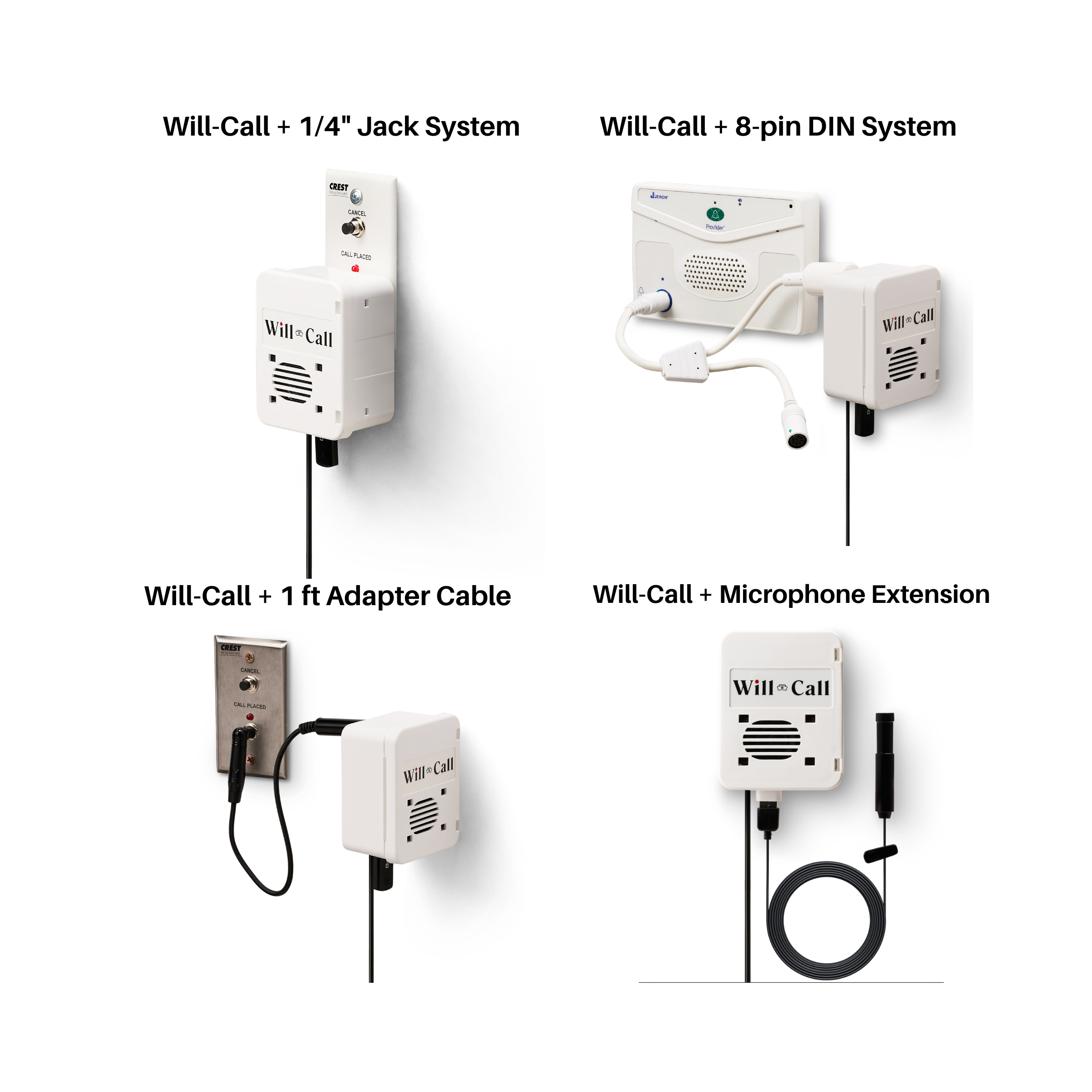
Will-Call connected to a standard 1/4 inch, 8-pin DIN nurse call wall jack, 1ft adapter cable and extended microphone
This guide is for maintenance leads, directors of nursing, and IT or biomed contacts who need to confirm whether Will-Call will physically work in their rooms before ordering. It explains what Will-Call plugs into, what stays the same in your existing setup, and what to check before placing an order.
If you only want the short version, the next section answers the core question in four sentences. If you want the full picture, including connector types, adapter scenarios, and what photos to send for a compatibility check, keep reading.
The Short Answer: What Will-Call Plugs Into
Will-Call is a voice activated nurse call system accessory that connects to a compatible existing nurse call system using a 1/4 inch phone plug. It plugs into the same nurse call wall jack or bedside receptacle that your current standard call button uses. When the resident says "I need help," Will-Call activates the existing nurse call pathway the same way pressing the standard button would. No Wi-Fi, no app, and no changes to your nurse call infrastructure are required for normal use.
If your bedside receptacle accepts a 1/4 inch phone plug, Will-Call is likely a direct connection. If it uses a different connector type, an adapter may be available.
The Standard Connection: 1/4 Inch Phone Plug
Will-Call uses a standard 1/4 inch phone plug, the male connector at the end of the device cable. That plug goes into a 1/4 inch nurse call jack, which is the female receptacle in the wall plate, bedside panel, or pillow speaker port that currently accepts your standard call button.
The connection works the same way a wired call button connection works today:
- The male 1/4 inch plug seats into the female jack.
- The nurse call system sees an activation event on that input.
- The call light, dome light, and nursing station alert behave exactly as they normally would.
Nothing about how the nurse call system signals staff changes. Will-Call is an accessory on the resident side of the connection. It gives the resident another way to activate the call, but the rest of the workflow stays the same.
What About Other Connector Types? (Adapters and Common Scenarios)
Not every nurse call system uses a 1/4 inch jack at the bedside. Some use 8-pin DIN, RJ45 8-pin, RJ50 10-pin, DB37, or proprietary connectors specific to the system manufacturer.
For some of these, an adapter is available that lets Will-Call connect into the existing receptacle without rewiring the system. Common scenarios we see:
- A bedside receptacle that uses 8-pin DIN, where an adapter converts the existing connection to a 1/4 inch path for Will-Call.
- A wall plate that includes both a standard call button receptacle and a separate accessory port, where Will-Call uses one path and the standard button continues to use the other.
- A Y-style adapter that allows the existing standard call button and Will-Call to share the same input.
Adapter availability depends on the specific system and connector. This is the part of the setup that benefits most from sending a photo of your wall jack or bedside panel before ordering. A two-minute look at the receptacle is usually enough to confirm the path.
Does Will-Call Work With All Nurse Call Systems?
No product works with every nurse call system, and we do not claim otherwise. Will-Call is designed to connect to compatible existing nurse call systems. Compatibility depends on the system, the connector type at the bedside, and the room setup.
Nurse call systems that have been used with Will-Call in facility settings include certain configurations of:
- Rauland Responder (various models)
- TekTone Tek-CARE
- Jeron Pro-Alert and Provider
- Intercall Legend II
- West-Com
- Other legacy systems through adapters
This list reflects systems where Will-Call has worked in real facility deployments. It is not a guarantee that every model, generation, or installation of these systems will be compatible. Compatibility within a single brand can vary by model age, wiring, and installed connector type. A short compatibility check before ordering removes the guesswork.
If your system is older or the original vendor no longer supports it, that does not automatically rule out Will-Call. Several Will-Call deployments are in facilities with legacy systems where the bedside connection still functions but the original vendor relationship is gone. At Maple Lawn Nursing and Rehab, for example, Will-Call was set up for a resident with ALS using a custom adapter for an older Jeron system.
What Stays the Same in Your Existing Setup
This is usually the part that matters most to maintenance and DON leadership. Will-Call is an accessory, not a replacement.
What stays the same:
- The nurse call system itself, including the head-end, wiring, and nursing station console
- Dome lights, corridor lights, and call routing behavior
- The standard call button (in most setups it remains functional alongside Will-Call, depending on configuration)
- Nursing workflow, response protocols, and documentation
- The nurse call vendor relationship, if you have one
What is added:
- The Will-Call device, placed bedside
- A microphone, either built in or extended depending on the room and the resident's voice
- A power connection for the device
- The voice activation pathway for the resident
Will-Call is not a new nurse call system. It is a way for a specific resident to activate the one you already have.
Does Will-Call Require Wi-Fi, an App, or IT Involvement?
No. Will-Call does not use Wi-Fi, Bluetooth, an app, or a cloud account for normal use. It does not connect to the facility network. There is no patient data transmitted, stored, or displayed by the device.
For most facilities, this means:
- IT does not need to provision the device on the network.
- Biomed does not need to run a cybersecurity review for network connectivity, because there is no network connectivity.
- Cybersecurity policies tied to networked medical devices generally do not apply, because Will-Call does not join the network.
Facilities with strict review processes for any new bedside device may still want IT or biomed to be informed, even when no network connection exists. That is reasonable and we support it. The point is that the technical scope of the review is small because the device's connection to the outside world is, by design, not there.
What to Check Before Ordering
A short pre-order check reduces the chance of surprises at install. Walk through this list before placing an order, especially for the first room in a facility:
- The nurse call brand and, if known, the model
- The connector type at the bedside receptacle (1/4 inch jack, 8-pin DIN, RJ45, RJ50, other)
- Whether the existing standard call button is currently functional
- Where the wall jack or bedside panel is located relative to the bed
- Whether there is an accessible power outlet near the intended Will-Call placement
- The resident's typical position in the room (helps with microphone placement)
- Any unusual room conditions (high ambient noise, TV placement, roommate in shared room)
If anything on this list is unclear, the easiest path is to send a photo of the wall jack or bedside connector to the Will-Call team. A photo is usually enough to confirm the connector type and recommend any needed adapter or extension.
What Photos and Details to Share With Will-Call
Before ordering, share three things:
- A close-up photo of the wall jack or bedside receptacle where the standard call button currently plugs in
- A wider photo of the bedside panel and the surrounding area, so the team can see the layout
- A short note on the nurse call brand and model, if known, and a one-line description of the resident's situation
That is enough for the Will-Call team to confirm compatibility, recommend the right cable length or extension, and flag whether an adapter is needed. For facilities planning to use Will-Call in more than one room, the same photo set from each room speeds up the process.
Frequently Asked Questions
Can the existing standard call button still be used alongside Will-Call? In many setups, yes. Depending on the bedside configuration and whether a Y-style adapter is used, the standard call button can remain available while Will-Call provides the voice activation pathway. The specifics depend on the room and system, which is why a photo helps.
What happens if the wall jack is in a hard-to-reach location? A 1/4 inch extension cable can reposition the Will-Call connection point, and a right-angle plug is available for tight spaces behind beds or furniture. Microphone placement can also be adjusted with an extended microphone cable so the device sits in a practical location without making the resident strain to be heard.
Do we need to involve our nurse call vendor? For most installations, no. Will-Call plugs into the existing bedside receptacle without changing the nurse call system, so vendor involvement is usually not required. If your facility has a policy that any change at the bedside requires vendor notification, that policy applies here too, but the technical scope is small.
What if our nurse call system is older or no longer supported by the vendor? A legacy or unsupported system is not an automatic disqualifier. Will-Call has been used in facilities with legacy nurse call systems through adapters. Send a photo of the connector and we can confirm whether a path exists.
Can Will-Call be moved from room to room? Yes. Will-Call is not permanently installed. If a resident moves rooms or a different resident in another room has a similar access need, the device can be unplugged, moved, and reconnected. The new room's bedside receptacle needs to be compatible (or use the same adapter type) for a direct swap.
What if the resident's voice is soft? Does that affect the connection or just the microphone setup? The physical connection to the nurse call system is not affected by voice volume. What matters is microphone placement. For residents with softer voices, an extended microphone positioned closer to the resident usually solves the issue. This is discussed during the compatibility check so the right microphone setup ships with the device.
Next Step: Confirm Compatibility for Your Setup
The fastest way to know whether Will-Call will work in your facility is to send a photo of the bedside receptacle and a short note about the nurse call system. The Will-Call team will confirm the connector match, recommend any adapter or extension needed, and walk through the setup before anything ships.
If you want to evaluate Will-Call in a specific room before broader deployment, the 30-day Test Drive program lets you install the device for one resident and confirm fit in your environment first.
Send a photo, ask a question, or request a Test Drive through the Will-Call contact page.