
What Is Will-Call? A Voice-Activated Nurse Call Accessory Explained
This page is for administrators, Directors of Nursing, family advocates, and anyone who has come across the name Will-Call and wants a clear explanation before forwarding it to a colleague or considering it for a specific resident. It covers what the product is, how it works, who it is for, and what it is not.
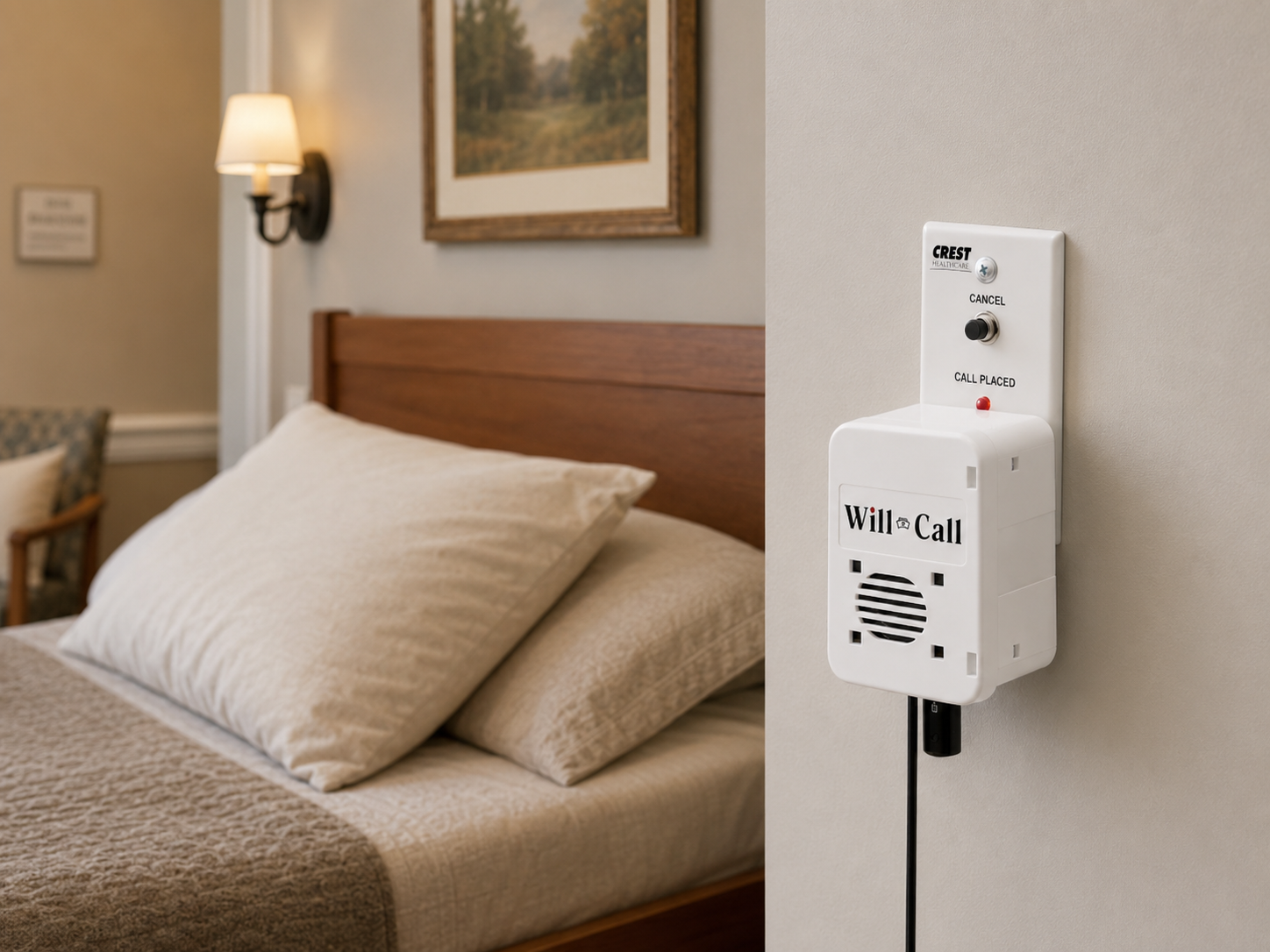
Will-Call is a voice-activated nurse call accessory. A person says "I need help," and the existing nurse call system in their room activates the same way it would if a button were pressed. No Wi-Fi. No app. No replacement of the nurse call infrastructure already on the wall.
That is the short answer. The rest of this page explains the parts involved, the kind of resident it is designed for, and the questions most readers ask before deciding whether to look closer.
How Does Will-Call Work?
Will-Call is a small device that plugs into the existing nurse call jack at a resident's bedside, in place of the standard call button. The standard button can usually be reconnected through an adapter so both the button and Will-Call are active at the same time.
Once plugged in, Will-Call listens for one specific phrase: I need help. When it hears that phrase, it sends the same signal to the nurse call system that a pressed button would send. The call light goes on. The signal reaches the nurse station. Staff respond the way they normally do.
Will-Call also speaks back to the resident after activation: "Okay, I've called someone to help you." That confirmation matters. A resident who cannot see the call light or hear the hallway dome light needs to know the request was received.
Key point: Will-Call does not replace, bypass, or modify the nurse call system. It activates the same signal path that already exists. From the facility's perspective, the call comes through normally..>
The device works offline. There is no account to set up, no software to install, no network to connect. Setup in a compatible room typically involves plugging it in, placing the microphone near the resident, testing the phrase a few times, and confirming the call reaches the nurse station.
Who Is Will-Call For?
The primary fit is a resident who can speak a short phrase clearly and consistently, but cannot reliably press, grip, reach, or locate a standard call button.
This includes residents with:
- ALS, advanced MS, muscular dystrophy, and other progressive motor conditions where hand and arm function has changed but speech is still present
- Parkinson's disease with tremor or rigidity that makes button activation inconsistent
- Quadriplegia or significant upper-limb paralysis following spinal injury or stroke
- Severe arthritis, contractures, or grip weakness that prevent reliable button press
- Positioning challenges where the button slides under the body, falls off the bed, or moves out of reach during the day
The pattern across these situations is the same: the resident can communicate verbally, but the physical call button is no longer a reliable access point.
When the resident cannot speak the phrase reliably
Voice is the primary activation method, and it should be assessed honestly. A resident who has lost reliable speech, whose voice is too quiet to detect across a room, or whose cognition prevents them from retaining and using the phrase is not a candidate for voice activation alone.
For these residents, Will-Call can still be part of the answer through a different input path. One family worked with their daughter's care team to connect Will-Call to her eye-gaze communication device. She selects the phrase "I need help" on her eye-gaze screen, the device speaks it aloud, and Will-Call activates the nurse call from there. The full story is published here: voice-activated call light for ALS, supported by an eye-gaze communication system.
This is not the standard use case, and it requires that the resident already has an AAC device they use reliably. But it shows that Will-Call's activation pathway can be reached by augmentative and alternative communication (AAC) technology when direct voice is not available.
When Will-Call is not the right answer
- The resident cannot reliably produce speech and does not use AAC technology that can speak a phrase aloud
- The resident cannot retain or use the activation phrase due to cognitive condition
- The room's nurse call system is not compatible (this should be checked before ordering)
- The resident needs continuous monitoring rather than on-demand call access — Will-Call is a call-access accessory, not a monitoring system
A fit assessment usually involves the resident, a family member or OT, and someone who knows the room's nurse call setup. The brief version of that assessment: can the resident speak the phrase clearly across different times of day, and does the room's call system accept a standard plug-in accessory?
Does Will-Call Replace the Nurse Call System?
No. Will-Call works alongside the existing system.
This is the single most common point of confusion in early conversations. Administrators often assume that voice activation requires a new nurse call platform, vendor change, IT project, or capital expense. None of that is true. Will-Call is an accessory that uses the call pathway already installed in the room.
The standard call button can remain available. Staff workflows do not change. Documentation does not change. The nurse station sees the same call alert it always has.
What changes is the resident's ability to reach the system. That is the whole point.
“We didn’t have to change anything about our nurse call system. She can just say ‘I need help’ and the nurse light goes on.”
Does Will-Call Require Wi-Fi, Bluetooth, or an App?
No. Will-Call is designed to operate without any of these.
There is no Wi-Fi connection, no Bluetooth pairing, no app installation, no account creation, no cloud login, and no subscription. The device does not transmit audio off the unit and is not designed to collect or store the resident's speech.
This matters for three practical reasons:
- IT involvement stays minimal. Facilities that have spent years locking down networks do not have to add another connected device to manage.
- Privacy concerns are simpler to explain. The device listens locally for one phrase. It does not record conversations or send audio anywhere.
- Reliability does not depend on network uptime. Wi-Fi outages, router changes, and ISP issues do not affect whether the resident can call for help.
What Will-Call Is Not
Some of the most useful clarity comes from naming what the product is not. These distinctions matter because they shape who should consider Will-Call and how it should be described internally.
| Will-Call is not | Why this matters |
|---|---|
| A smart speaker or voice assistant | It does not answer questions, play music, control devices, or connect to a smart home ecosystem. It listens for one phrase and activates one signal. |
| A medical device | Will-Call is an assistive call-access accessory. It is not intended to diagnose, treat, cure, mitigate, or prevent disease. |
| A replacement nurse call system | It works with a compatible existing nurse call system. It does not replace the panel, wiring, dome lights, or nurse station equipment. |
| A monitoring or surveillance tool | It does not track location, record audio continuously, or transmit data off the device. |
| A fall detector or PERS device | It does not detect motion or falls. It activates only when the resident speaks the phrase, or when an AAC device speaks the phrase on their behalf. |
| A guarantee of response | It activates the existing nurse call system. Staff response time and protocols are determined by the facility, not the device. |
How to Know If Will-Call May Be a Fit
A short readiness check before any purchase or trial conversation
- Identify the specific resident or residents whose access to the standard call button has become unreliable
- Confirm the resident can speak a short phrase clearly across different times of day, or uses an AAC device that can speak a phrase aloud
- Check that the existing nurse call system uses a standard plug-in connector (often a 1/4-inch jack, though some legacy systems use different connectors and may need an adapter)
- Identify who in the facility will handle plug-in setup: maintenance, the nurse call vendor, or a family member in a home setting
- Decide whether the standard button will remain in place alongside Will-Call (most setups keep both)
If most of these check out, Will-Call is worth a closer look. The next step is usually a compatibility check or a 30-day Test Drive in a real room with a real resident.
Frequently Asked Questions
Is Will-Call a medical device? No. Will-Call is an assistive call-access accessory. It is not intended to diagnose, treat, cure, mitigate, or prevent disease, and it should not be described as a medical device.
Does Will-Call work with every nurse call system? No. Will-Call works with compatible nurse call systems. Compatibility depends on the connector type, the system manufacturer, and the room setup. A photo of the existing call button and wall jack usually answers the compatibility question quickly.
Can a family member buy Will-Call for a loved one in a facility? Yes, in many cases. Facility policies vary, so the family advocate and the facility's administrator or DON should confirm that the device can be installed in the resident's room. Will-Call is often introduced this way, with the family bringing it forward and the facility approving the plug-in.
What is the activation phrase? "I need help." The phrase is fixed and is what Will-Call listens for.
Does Will-Call record or monitor what the resident says? Will-Call is not designed to record conversations, store audio, or transmit speech off the device. It listens locally for the activation phrase.
What if the resident's voice changes over time? For progressive conditions like ALS, voice strength and clarity can change. Reassessment over time is appropriate. When direct voice is no longer reliable, some families have used an AAC device, such as an eye-gaze communication system, to speak the activation phrase aloud and trigger Will-Call that way.
See If Will-Call Fits Your Situation
Will-Call is built around one specific access gap: residents who can communicate the need for help but cannot reliably press the standard button. If that describes a resident you are thinking about, the next step is a short conversation about the room, the system, and the resident.
Request a 30-day Test Drive or read more customer stories to see how facilities and families have used Will-Call in real rooms.