
How Will-Call Is Different from a Standard Nurse Call Button
This article is for facility administrators, directors of nursing, and family advocates trying to understand what actually happens when Will-Call is added to a room that already has a nurse call system. It explains the mechanical relationship between a standard call button and Will-Call, what changes, what stays the same, and who this voice-activated nurse call device is for.
Will-Call is not a new nurse call system. It plugs into the same wall jack a standard call button uses and closes the same circuit. The nurse station sees the same signal. The call light behaves the same way. The only thing that changes is how the circuit gets closed: a finger press or a spoken phrase.
That is the whole idea. Everything below explains it.
How a Standard Nurse Call Button Works
A nurse call button is a simple switch. Inside the button, two electrical contacts sit open. When a resident presses the button, those contacts touch. That closed circuit sends a signal through the wall jack, down through the nurse call wiring, and into the facility's nurse call system.
From there, the nurse call system does everything it normally does:
- The dome light outside the room activates
- The call registers at the nurse station
- The corridor light activates
- Staff responds and resets the call at the station or in the room
The button itself is not doing the alerting. The button is doing one job: closing a circuit. The nurse call system handles the rest.
This matters for the rest of the article. When people ask, "does Will-Call replace the nurse call system?" the answer starts here. The nurse call system is the infrastructure. The button is the trigger. Will-Call is a different kind of trigger for the same infrastructure.
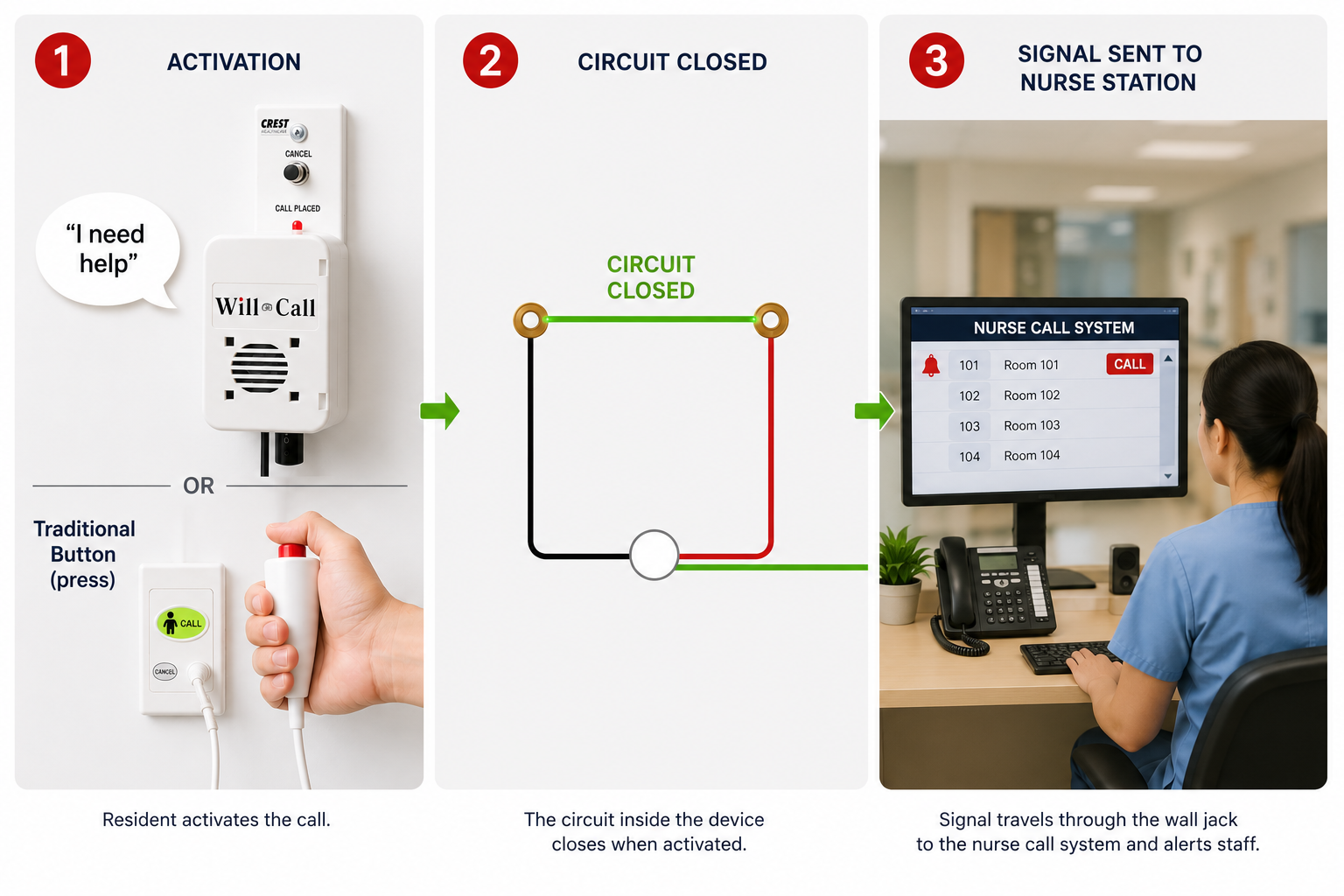
The activation method changes. Everything downstream stays the same.
How Will-Call Works
Will-Call plugs into the same 1/4-inch nurse call jack a standard call button uses. When Will-Call hears the activation phrase "I need help," it closes the same circuit a button press would close. The signal that reaches the nurse call system is identical.
Everything downstream is unchanged:
- The dome light activates
- The call registers at the nurse station
- Corridor lights activate
- Staff responds and resets the call the same way
Will-Call also gives the resident a verbal confirmation ("Okay, I've called someone to help you") so they know the alert went through. The nurse call system does not need this confirmation. It is for the resident.
Key point: The nurse call system does not know, and does not need to know, whether the circuit was closed by a finger or by a voice. It receives the same signal either way.
Will-Call does not require Wi-Fi, Bluetooth, an app, or a cloud account. It is a physical accessory that connects to a physical jack.
A note on residents who cannot speak
The activation phrase does not have to come from the resident's mouth. Residents who use eye-gaze devices, speech-generating devices, or other augmentative and alternative communication (AAC) devices can produce the phrase "I need help" through their device. Will-Call detects the phrase the same way it detects a spoken voice.
For a real example of this, see the voice-activated call light for a resident with ALS who used an eye-gaze communication system.
What Changes and What Stays the Same
Here is the side-by-side view most facility teams want:
| Element | Standard Call Button | Will-Call |
|---|---|---|
| Wall jack used | 1/4-inch nurse call jack | Same 1/4-inch nurse call jack |
| How the circuit is closed | Physical press | Voice activation: “I need help” |
| Signal to nurse call system | Standard call signal | Same standard call signal |
| Dome light, corridor light, nurse station | Activates normally | Activates normally |
| Staff response workflow | Unchanged | Unchanged |
| Documentation and reset | Unchanged | Unchanged |
| Wi-Fi, Bluetooth, or internet required | No | No |
| Nurse call system modification | None | None |
The activation method changes. Nothing downstream changes.
This is why Will-Call is described as a nurse call accessory rather than a nurse call system. It sits at the trigger layer, not the infrastructure layer.
Who Will-Call Is For
Will-Call is designed for residents who can produce the activation phrase but cannot reliably press a standard call button.
The most common situations:
- A resident whose grip is inconsistent day to day, so pressing works sometimes and not others
- A resident who drops the call cord and cannot locate or retrieve it
- A resident whose call cord ends up trapped under their body or bed linens
- A resident who can speak clearly but has limited hand or arm function
- A resident who uses an eye-gaze device, speech-generating device, or other AAC device to produce speech
For a real facility example, see how a veteran with Parkinson's added a voice-activated option to his TekTone setup.
"Some days he could press the button. Some days he could not. The variability was the whole problem."
"She can talk but she can't press."
— Common phraseS from family advocates describing residents who become good candidates for Will-Call
Who Will-Call Is Not For
Will-Call is one option to consider based on the resident's specific abilities. It is not a fit for every resident with mobility limitations.
Will-Call is generally not the right option when:
- The resident cannot reliably produce the activation phrase (through voice or an AAC device) across different times of day
- The resident does not understand when or why to call for help
- The room environment cannot support reliable voice detection (constant loud audio, uncontrolled roommate audio, etc.)
The standard call button remains available in most setups, so residents who can use it continue to use it. Will-Call is for the residents it does not work for.
What to Check Before Deciding
Before ordering Will-Call for a specific resident, a short list to work through:
- What nurse call system does the facility use? (Rauland, TekTone, Jeron, West-Com, and others have been used with Will-Call in compatible setups. Compatibility should be confirmed for your specific system.)
- What connector type does the wall jack use? A 1/4-inch jack connects directly. Other connectors may need an adapter.
- Can the resident produce the activation phrase reliably, either by voice or through an AAC device?
- What is the room's audio environment? Is there a roommate with a loud TV, or other constant background noise that would interfere?
- Where would the microphone be placed for reliable detection given the resident's position?
For a real example of how microphone placement was handled in a shared room, see what setup looked like for a resident with advanced MS.
If you are not sure about compatibility, sending a photo of the nurse call panel and the wall jack is usually the fastest way to confirm fit.
Frequently Asked Questions
Does Will-Call replace the nurse call system?
No. Will-Call is a voice-activated nurse call accessory. It connects to the existing nurse call system using the same wall jack a standard call button uses and closes the same circuit. The nurse call system, the dome light, the nurse station, and the staff workflow are unchanged.
Can the standard call button still be used if Will-Call is installed?
In most setups, yes. The standard call button remains available. Will-Call adds a second activation method for residents who cannot reliably use the button. Specific setups vary by nurse call system and connector, so this should be confirmed for the room.
Does Will-Call require Wi-Fi or Bluetooth?
No. Will-Call does not use Wi-Fi, Bluetooth, an app, or a cloud account. It is a physical accessory that plugs into the nurse call jack.
Does the nurse call system need to be modified or reprogrammed?
No. The nurse call system receives the same signal from Will-Call that it receives from a standard button press. No modification, reprogramming, or IT involvement at the system level is required.
What if a resident's voice is soft or their speech is unclear?
Voice reliability matters. In some cases, an extended microphone placed closer to the resident helps. In cases where the resident's spoken voice is not consistent enough for reliable detection, an AAC device that produces the phrase "I need help" can be used to activate Will-Call.
Will Will-Call work with our specific nurse call system?
Will-Call is designed to work with compatible existing nurse call systems that use a 1/4-inch jack directly or through an adapter. Compatibility should be confirmed for your specific system and room setup. Sending a photo of the nurse call panel is usually the fastest way to check.
Can we test Will-Call with one resident before ordering more?
Yes. The 30-day Test Drive program is designed for exactly this. A facility identifies one resident, tests Will-Call in that room, and decides whether to keep it based on the real setup.
Next Step
If a resident in your facility can produce the phrase "I need help" but cannot reliably press the call button, a Test Drive is the easiest way to evaluate fit in the actual room.
Request a 30-day Test Drive for one resident.
If you are not sure about compatibility with your nurse call system, send us a photo of the nurse call panel and we will confirm fit before you commit to anything.