
Call Light Access for Residents with Quadriplegia: A Practical Guide for Care Teams
Quadriplegia (also called tetraplegia) describes paralysis affecting all four limbs, usually the result of a cervical spinal cord injury. Paraplegia affects the lower body only. The difference matters here because residents with quadriplegia often retain speech, cognition, and some head or facial movement, but lose the hand and arm function a standard call cord assumes.
That gap between what the standard system requires and what the resident can actually do is the reason this guide exists.
According to the National Spinal Cord Injury Statistical Center, about 60% of new spinal cord injuries result in tetraplegia, and the average age at injury has been rising. More of these residents are entering skilled nursing, long-term care, and rehab settings after acute care ends. Call access for this population is not an edge case. It is a recurring operational reality that lands on the desk of the occupational therapist, the DON, and the family advocate.
This guide is written for those three readers. It covers how to assess call access for a resident with quadriplegia, the adaptive methods currently used in care settings, and how to decide which one fits which resident.
Why this guide exists
Will-Call was built by Bob Kaiser after his brother Will, who has quadriplegia, fell out of bed one night and could not call for help. The only call access Will had was a standard nurse call cord, and he could not use it.
Bob has been Will's caregiver for the last four years. In that time, Will has been admitted to multiple hospitals for various health conditions. Will-Call has traveled with him to each admission and has connected to every nurse call system it has encountered.
That experience shapes this guide in a specific way. Because the founder has lived on the caregiver side of this problem, this guide does not treat voice access as automatically the right answer for every resident with quadriplegia. It treats sip-and-puff, head switches, and voice access with the same honesty. No single method fits every resident, and the wrong method chosen quickly can create new problems, including skin issues, oral infection risk, and additional staff workload for repositioning and troubleshooting.
The point of this guide is to help care teams make the right call for a specific person.
How does a resident with quadriplegia call for help when the standard cord doesn't work?
Directly: through an adaptive access method matched to the resident's preserved function. The main established options are sip-and-puff switches, head or chin switches, pressure and pneumatic switches, and voice-activated access. Each requires a different capability from the resident, has different positioning demands on staff, and carries different tradeoffs for daily use.
The right method is not chosen by injury level. It is chosen by what the resident can reliably do, hour to hour, across a normal day.
Key principle: Two residents with the same injury level can need entirely different call access methods. Start with what the resident can reliably do. The diagnosis informs the assessment. It does not determine the answer.
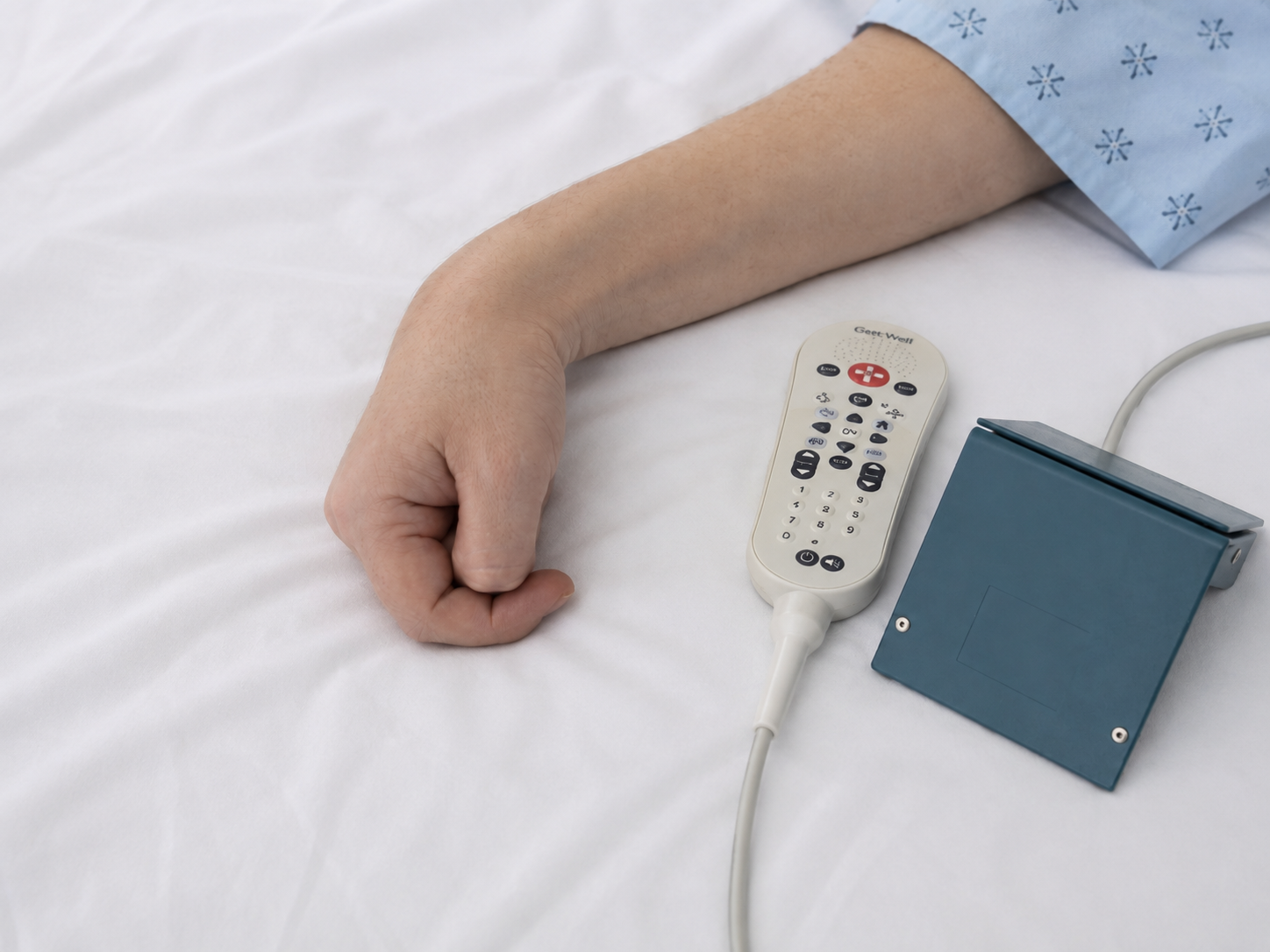
For residents with quadriplegia, limited hand function can make traditional call lights and push pads difficult to access reliably.
Why injury level alone doesn't tell you which system fits
It is tempting to build a decision tree from injury level. C1 through C4 goes here. C5 through C8 goes there. But the American Occupational Therapy Association's practice guidance for adults with spinal cord injury is explicit on this point: access technology decisions should be based on preserved motor function, respiratory status, cognitive status, communication ability, and the person's stated preferences. Not injury level alone.
Injury level is a starting frame. Two residents with C4 injuries can have very different retained function depending on the completeness of the injury, rehabilitation history, respiratory support, spasticity patterns, and time since injury. One may have reliable head movement. The other may not. One may be off the ventilator during the day and use a speaking valve. The other may not.
The practical assessment questions are functional:
- Can the resident reliably speak a short phrase across different times of day and different levels of fatigue?
- Does the resident have reliable head movement of sufficient range and consistency to activate a switch?
- Is the resident on ventilator support, and if so, do they use a speaking valve?
- Can the resident tolerate an oral interface for extended periods without skin breakdown or discomfort?
- Does the resident's function change significantly at night, when call access matters most?
- What has the resident told you they want to use?
The last question is the one that gets skipped most often and matters most. A method the resident dislikes will be used less and reported as broken more.
The adaptive call access options currently used in care settings
Four modalities cover most of what care teams are actually choosing between. The Christopher & Dana Reeve Foundation's Paralysis Resource Center lists voice-activated systems, sip-and-puff, and head-controlled switches as the primary input methods for people with limited or no hand function. None of them is new. Each has a real fit and a real limit.
Sip-and-puff switches
Sip-and-puff uses a straw-like mouthpiece. The resident sips or puffs into it to trigger a switch, which activates the call system.
Where it fits: Residents with reliable breath control and oral motor function, especially those who are already using sip-and-puff for other environmental control (wheelchair, computer). Familiarity matters. A resident who already uses sip-and-puff for their wheelchair often prefers it for call access too.
Real limits to be honest about:
- Oral hygiene and infection risk. The mouthpiece sits at the mouth constantly. It requires cleaning protocols to reduce risk of oral bacterial buildup and aspiration concerns.
- Comfort over time. Reddit threads from users with quadriplegia repeatedly describe the same complaint: "the tube irritates my mouth" after extended wear.
- Positioning burden on staff. The mouthpiece has to be repositioned when the resident moves, and it can shift out of reach during sleep.
- Not usable when the resident is eating, drinking, or receiving oral care.
Head, chin, and pneumatic switches
A switch mounted on the headrest, pillow, or a positioning arm. The resident activates it with a head turn, chin movement, or a light touch.
Where it fits: Residents with reliable, repeatable head or chin movement of sufficient range. Often paired with a pressure switch calibrated to the resident's strength.
Real limits to be honest about:
- Positioning is precise and fragile. A user in a spinal cord injury community thread put it plainly: "the switch kept moving out of position." A switch that worked at 8 a.m. may not work at 2 a.m. after the resident has been repositioned twice.
- Staff workload. Every reposition means re-verifying switch placement. On a busy shift, this is where things quietly fail.
- Fatigue. Repeated head movement can be tiring for residents with limited neck strength.
- Spasticity can trigger false activations, which staff learn to ignore, which then makes real calls easier to miss.
Pressure pads and light-touch switches
Pads placed under a hand, arm, or head that activate when pressed. Common as a low-tech option.
Where it fits: Residents with some retained pressure capability in a hand, forearm, or head, even if they cannot grip or press a standard button.
Real limits to be honest about:
- Slippage. Pads move when the resident moves, and the resident often cannot reposition them.
- False activations from involuntary movement or spasticity.
- The resident has to know where the pad is, which becomes difficult if it shifts under bedding.
Voice-activated access
The resident speaks a phrase to activate the nurse call system. No hand, mouth, or head movement is required.
Where it fits: Residents who can speak a short phrase clearly and consistently across a normal day. The ALS Association's assistive technology guidance names voice-activated environmental control as a recommended option "while speech remains reliable," and pairs it with sip-and-puff and switch access as parallel options for progressive conditions.
Real limits to be honest about:
- Requires reliable speech. Ventilator-dependent residents may need a speaking valve to use voice access effectively, and speech reliability can vary with fatigue, positioning, and time of day.
- Microphone placement matters. A microphone too far from the resident, or blocked by pillows or bedding, will miss activations.
- Not appropriate for residents with cognitive limitations that prevent them from retaining and reliably using an activation phrase.
- Ambient noise from televisions, roommates, or hallway activity can affect reliability and should be evaluated in the actual room.
Voice access is a recognized modality, not novel. But it is not a universal answer. A resident who cannot reliably speak, or who cannot retain the activation phrase, is not a candidate.
How voice-activated access fits the quadriplegia context
For a resident with a C1 to C4 injury who retains reliable speech, voice access removes a significant amount of the positioning and repositioning work that sip-and-puff and head switches require. There is no mouthpiece to clean, no switch to recalibrate after each turn, no pad to slide back into place. The resident speaks, and the call activates.
That reduction in daily positioning work matters both for the resident and for the staff carrying that workload across a shift.
Will-Call is one voice-accessible option in this space. It is designed to give a resident another way to activate a compatible existing nurse call system by saying the trigger phrase. It connects to the existing nurse call jack in the room, does not require Wi-Fi or an app, and works with many common nurse call systems, though compatibility should be confirmed for the specific room and system.
Because Bob has been the caregiver on the other side of this problem, Will-Call has been used across multiple hospital admissions during Will's care and has connected to each nurse call system encountered. That is a factual reference point, not a claim about outcomes in any other facility.
If you want to see whether voice access fits a specific resident's room and system, you can request a 30-day test drive.
When voice-activated access is not the right fit
Voice access is not the answer for every resident with quadriplegia. Situations where another method is likely better:
- The resident is ventilator-dependent without a speaking valve, or speech is unreliable across the day
- The resident has cognitive limitations that prevent reliable use of an activation phrase
- The room has persistent ambient noise (a roommate's television, a shared space with heavy hallway traffic) that cannot be mitigated
- The resident has told the care team they prefer sip-and-puff or a switch method they are already using for other environmental control
The same organizations that recommend voice access also acknowledge its limits. The right call for a specific resident is made by the OT and the clinical team, not by a device manufacturer and not by a family advocate reading a guide. This guide is meant to help that conversation, not replace it.
How adaptive call access connects to the existing nurse call system
Whatever method the team selects, it has to activate the nurse call system the facility already has. Sip-and-puff, switches, and voice-accessible devices generally connect through the existing bedside jack, either directly with a 1/4-inch plug or through an adapter for systems that use a different connector.
Common questions to work through with maintenance or the facility's nurse call vendor:
- What connector type does the room's nurse call jack use? (1/4-inch, 8-pin DIN, RJ45, RJ50, other)
- Does the resident's room already have an adaptive switch input, or will a Y-adapter be needed to preserve the standard cord alongside the adaptive method?
- Where will the switch, mouthpiece, or microphone be positioned, and does that placement need a cable extension?
- Who will verify positioning at each shift change?
Facilities do not need to replace the nurse call system to add adaptive access. In most compatible setups, the adaptive method plugs into the same pathway the standard call button uses.
Frequently asked questions
Can a resident on a ventilator use voice-activated call access?
Possibly, with a speaking valve. Ventilator dependence affects speech reliability, and a speaking valve (such as a Passy-Muir valve) is often needed for the resident to produce speech that a voice-activated system can detect consistently. This should be assessed by the clinical team, including respiratory therapy and speech-language pathology, before selecting voice access as the primary method.
Does voice-activated call access work with an older nurse call system?
In many cases, yes. Will-Call is designed to work with compatible existing nurse call systems, including many legacy systems, through direct connection or an adapter. Compatibility should be confirmed for the specific room and system before ordering. A photo of the current bedside jack is usually enough to determine fit.
What if the resident's voice changes over time?
This is a real consideration for residents with progressive conditions and for residents whose speech reliability varies with fatigue or respiratory support. The care team should re-evaluate call access whenever the resident's function changes meaningfully. Voice access may be appropriate now and not appropriate in six months, or vice versa. The assessment is not a one-time event.
Who decides which call access method is right for a resident?
The occupational therapist, working with the resident, the family, nursing, and, where relevant, speech-language pathology and respiratory therapy. The decision should be capability-based and preference-informed. Facility leadership can support the process by making sure the OT has time to complete the assessment and that the resident's preferences are documented.
Can families bring a voice-activated call device into a facility?
Families do sometimes bring adaptive equipment into facilities, and this is often how a specific resident's access problem gets solved. The device should be reviewed with the DON, maintenance, and the resident's care plan so that setup, compatibility, and staff awareness are all addressed before it is put into use.
Has Will-Call been used in hospital settings?
Yes. Will-Call has traveled with the founder's brother Will across multiple hospital admissions and has connected to each nurse call system encountered during his care. Setup and compatibility should still be confirmed for the specific room and system in any new setting.
A practical next step
If you are evaluating call access for a specific resident with quadriplegia, the most useful next step is a functional assessment by the OT working with the resident, the family, and, where relevant, respiratory and speech. That assessment will tell you which adaptive method fits.
If voice-accessible call support looks like a possible fit for that resident, you can request a 30-day test drive to evaluate it in the actual room with the actual system. Send a photo of the bedside nurse call jack and a short note about the resident's situation, and the Will-Call team will help determine whether the setup is compatible.