
Is Will-Call Right for This Resident? A Suitability Guide for OTs and Rehab Teams
You have a resident who cannot reliably use the standard call button. You have heard about voice-activated nurse call. Now you need to decide whether it fits this specific person, or whether another adaptive option would serve them better.
This guide walks through the clinical thinking. It is written for occupational therapists, rehab teams, and directors of nursing who are matching a resident to an access method, not shopping for a device.
Voice-activated nurse call for residents can be a strong fit, a partial fit, or the wrong choice, depending on the resident's abilities, the room environment, and the existing nurse call system. The decision is about the person, not the diagnosis.
Suitability is About the Resident, Not the Diagnosis
Two residents with ALS can have very different call access needs. One may still speak clearly and consistently. Another may have weakened voice and need microphone adjustments. A third may have progressed past reliable speech and rely on an eye gaze device.
The same is true across every condition. A resident with advanced Parkinson's may have hypophonia that changes how voice activation is set up. A resident with corticobasal degeneration may still speak clearly but cannot locate a dropped call light. A resident with a C4 spinal cord injury may have full voice but no hand function at all.
> Key point:> The diagnosis informs the assessment. It does not determine the answer. Two residents with the same condition can need very different call access methods.
A scoping review of call light use in nursing homes found that call light systems are central to patient-staff communication, but access and usability vary significantly by resident ability. Standard call buttons are not universally accessible, and workarounds are common. The access problem is documented, not a marketing claim.
The question is not "does Will-Call work for ALS." The question is "does Will-Call work for this resident, in this room, connected to this nurse call system."
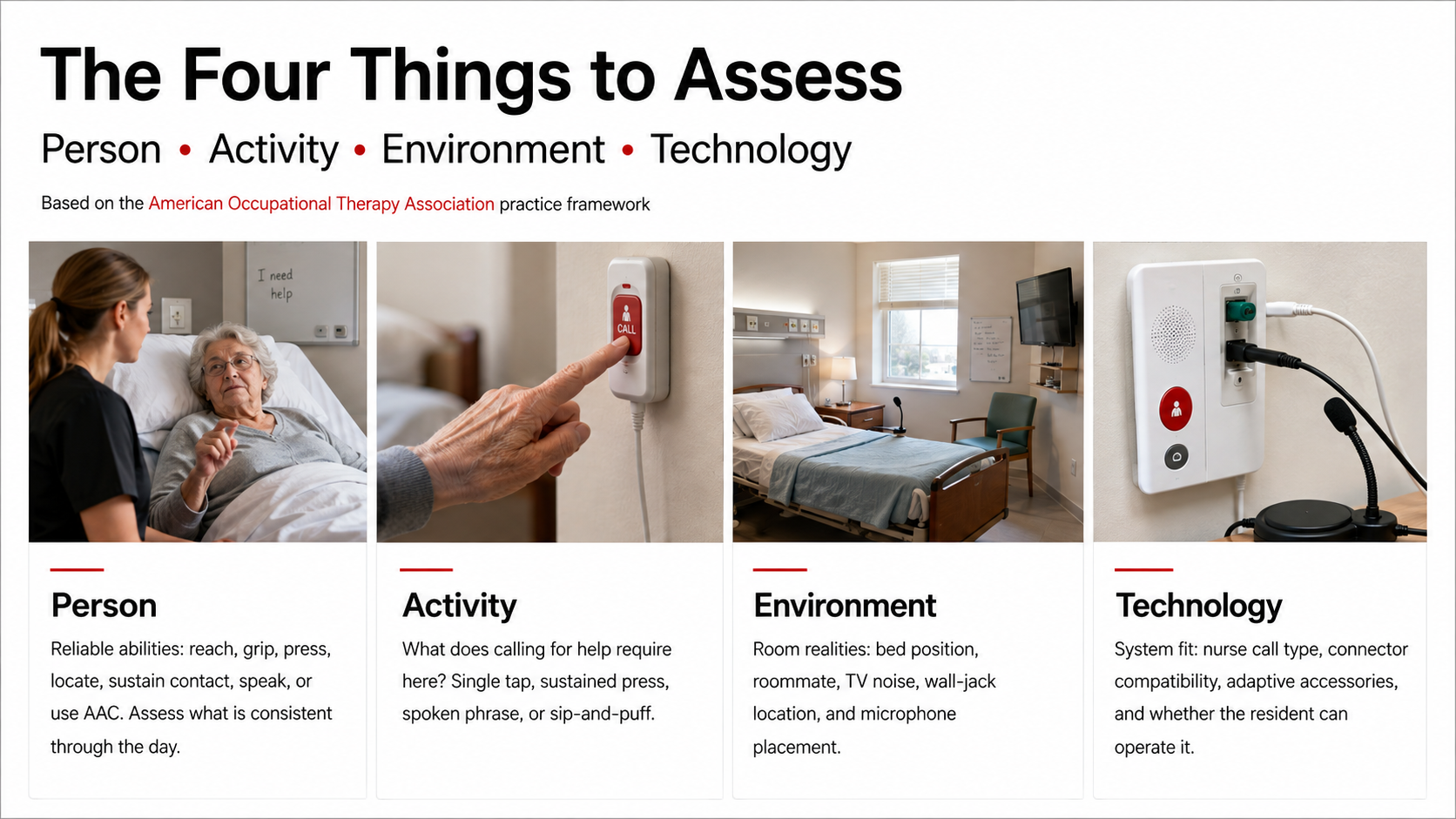
Assessment framework applied across call access options. Fit depends on the resident, activity, environment, and technology together.
The Four Things to Assess: Person, Activity, Environment, Technology
The American Occupational Therapy Association's practice framework for assistive technology assessment evaluates four domains together: the person, the activity, the environment, and the technology. Fit is determined by matching the person's reliable abilities to the demands of the device in the specific environment.
Applied to call light access, the four domains break down like this:
- Person: What can the resident reliably do? Reach, grip, press, locate, sustain contact, speak, or produce speech through an AAC device. What is reliable across the day, not just at their best moment.
- Activity: What does calling for help actually require in this facility? Sustained press, single tap, spoken phrase, sip-and-puff sequence.
- Environment: The room. Bed position, roommate presence, TV noise, wall jack location, where the microphone can be placed, whether the resident can be positioned consistently.
- Technology: The existing nurse call system, connector type, compatibility with adaptive accessories, and whether the resident can operate the specific device being considered.
The mistake most assessments make is stopping at Person. A resident who can speak a phrase clearly in a quiet exam room may not activate the same phrase reliably in a shared room with a TV on. A resident who can press a jelly bean switch in therapy may not sustain that ability three months from now. Fit is all four domains.
Can the Resident Produce the Activation Phrase Reliably?
Will-Call activates when the resident produces the phrase "I need help." There are three paths to producing that phrase, and each has different fit criteria.
Path 1: The resident speaks the phrase directly
This is the most straightforward path. It requires that the resident can:
- Speak a short phrase clearly enough to be recognized
- Do it consistently across different times of day, not only at their best
- Understand when to call for help and remember the phrase
A resident with advanced MS at The Reserve at Richardson could no longer use push buttons or a touch-sensitive pad, but could still speak. Voice was the reliable access method. A veteran with advanced Parkinson's at William F. Green State Veterans Home could press the button on some days but not others. Voice was more consistent than the button.
"She could press the button with her thumb some days, but not others. That variability was the whole problem."
— Care team observation, documented in Will-Call customer stories
Path 2: The resident speaks softly and needs microphone support
Some residents can speak, but not loudly. This includes residents with a tracheostomy, residents with hypophonia from advanced Parkinson's, and residents with weakened voice from progressive neuromuscular disease.
For these residents, standard microphone placement may not be enough. Will-Call offers extended microphones that can be placed close to the resident, and in specific cases, higher-sensitivity microphone options for softer speech. Placement is the variable that most often determines whether soft speech activates reliably.
This path requires testing in the actual room. A quiet voice that carries in a controlled setting may or may not carry in a shared room with ambient noise. Compatibility should be confirmed before ordering.
Path 3: The resident is non-verbal and uses an AAC or eye gaze device
For residents who cannot speak on their own, Will-Call may be compatible with AAC or eye gaze devices that can produce the phrase aloud. Tobii Dynavox, PRC-Saltillo, and similar devices can be programmed to speak stored phrases through their speaker. If that speaker is positioned close enough to the Will-Call microphone, the device-produced voice can activate the system.
This expands fit meaningfully. A non-verbal resident with locked-in syndrome, late-stage ALS, high-level spinal cord injury, or cerebral palsy who already uses an AAC device may be able to add "I need help" as a stored phrase and use the same device to activate the nurse call.
The fit criteria for this path:
- Resident has a functioning AAC or eye gaze device they can use reliably
- The device can be programmed to speak a specific phrase aloud
- The device's speaker can be positioned close to the Will-Call microphone
- The resident can reliably navigate to the stored phrase when they need help
If any of these are uncertain, this path needs to be tested before it is relied on.
Microphone Options for Residents with Soft Speech or with a tracheostomy
Microphone placement is the single most common variable in whether Will-Call activates reliably. For residents with soft speech, weakened voice, or a trach, placement matters more than any other setup decision.
The available options:
- Standard microphone. Works for residents who can speak at a normal conversational volume.
- Extended microphone. Allows placement closer to the resident's mouth, near a pillow or headboard. Useful for soft speakers, residents with hypophonia, and residents on a trach.
- Higher-sensitivity microphone options. Available in specific cases where extended placement is not enough. This is a targeted setup, not the default.
> Setup principle:> Placement is everything. A microphone six inches from the resident's mouth captures soft speech that the same microphone six feet away will miss. Test in the actual room before committing.
For a resident on a trach, plan on close placement and testing across different times of day. Speech volume may fluctuate with fatigue, positioning, and secretions. The test drive is the right time to identify whether soft speech is reliably captured.
Eye Gaze and AAC Compatibility for Non-Verbal Residents
For non-verbal residents, the traditional call light options are limited. Sip-and-puff requires oral motor control that some residents do not have. Pressure pads and jelly bean switches require reliable, sustained physical contact. For a resident who communicates through an eye gaze device, none of these may be a fit.
Will-Call opens a different path. If the resident's AAC or eye gaze device can be programmed to speak "I need help" aloud through its speaker, and the speaker can be positioned near the Will-Call microphone, the resident can activate the nurse call the same way a verbal resident would.
This is a meaningful expansion of fit for populations that have historically had fewer options: late-stage ALS, high cervical spinal cord injury, locked-in syndrome, advanced cerebral palsy with communication device use.
What to check before assuming this will work:
- Confirm the AAC or eye gaze device can be programmed to speak a specific phrase aloud (most can, but confirm the model)
- Plan speaker and microphone placement together, not separately
- Test with the resident actually using their device, not a staff member demonstrating it
- Confirm the resident can reliably navigate to and trigger the stored phrase
Will-Call may be compatible with AAC or eye gaze devices that can produce the trigger phrase aloud. Compatibility depends on the specific device, speaker placement, and testing in the actual room.
How Will-Call Compares to Other Adaptive Call Options
Every adaptive call option has trade-offs. The suitability decision is about matching the resident's reliable abilities and environment to the option that best fits both.