
From Sip-and-Puff to Voice: When It's Time to Rethink a Resident's Call Access Method
A caregiver in an ALS support forum recently asked a plain question about her father's sip-and-puff setup: "Is there a point in time when something like that wouldn't work?" That is the question this article is written to help answer, for occupational therapists, rehab leads, DONs, and family advocates working with a specific resident whose current sip-and-puff nurse call setup may no longer be the right fit.
Sip-and-puff is a well-established access method. It is not outdated, and it is not the wrong choice for every resident using it. But it is calibrated to a person's respiratory capacity, oral positioning, and daily stamina at a specific point in time, and those things change. This article covers how to recognize when it is time to reassess, how occupational therapists approach that decision, what the alternatives look like, and where voice-accessible call support may fit as one option among several.
Key takeaways:
- Sip-and-puff is calibrated to the resident's respiratory capacity at a moment in time; when that capacity changes, the device may stop detecting what it was set to detect
- Reassessment triggers include respiratory fatigue over the day, tube positioning problems, hygiene load on staff, calibration drift, and oral or skin discomfort
- Occupational therapists use a switch site hierarchy (hands, head, mouth, feet) but the current best access site is wherever the resident's most reliable intentional movement or capability lives now
- Voice-accessible call support is one alternative when the resident can produce the activation phrase audibly, either naturally or through an AAC device; it is not a universal replacement
When sip-and-puff may no longer be the right fit
The short answer: reassess when the resident is working harder to use the device than they used to, when the tube is causing positioning or comfort problems, when staff are managing more hygiene maintenance than the setup warrants, or when the resident's respiratory capacity has changed enough that the calibration no longer matches their reliable breath output. Any one of these on its own is a reason to look again. Two or more happening together usually means the current setup has drifted out of fit.
Reassessment does not automatically mean replacement. Sometimes the answer is adjusting mouthpiece position, recalibrating pressure sensitivity, or moving to a different switch site entirely. Sometimes the answer is a different access method. The point of reassessment is to match the tool to the person's most reliable current capability, not to keep using what was set up months or years ago.
Why sip-and-puff works, and where it breaks down
Sip-and-puff works because it uses a capability many residents with limited hand and arm function retain: the ability to produce controlled changes in air pressure through the mouth. A pneumatic sensor detects hard sips, soft sips, hard puffs, and soft puffs, and each pattern can be mapped to a switch action, including nurse call activation. For a resident who has lost reliable use of their hands but has intact respiratory control and oral coordination, it is a genuine solution.
The breakdown points are also real, and they are worth naming plainly.
Calibration is set to a moment in time
As the assistive technology community documents, "hard and soft are relative to the user and depend on their breathing abilities. Typically, air pressure levels pertaining to hard sips/puffs and soft sips/puffs are set through an initial calibration of the pressure sensor completed before the user starts to use their SNP device" (Wikipedia, Sip-and-puff). The calibration matches the user's respiratory capacity at that moment.
When respiratory capacity changes, whether from a progressive condition, medication effects, positioning during the day, or simple fatigue, the device may no longer detect what it was set to detect. A resident who could reliably produce a hard puff in the morning may only produce what the sensor reads as a soft puff by mid-afternoon. This is not a device malfunction. It is a match problem between a fixed calibration and a changing respiratory state.
Tube positioning is a documented problem
The physical setup of the mouthpiece and tube in front of the resident's face has been flagged as a known limitation, including in the patent literature. A pneumatic switching patent notes that "multiple sip-and-puff tubes are difficult to position and result in congestion in front of the user's face... a person who has limited head and neck mobility may have difficulty reaching all four tubes. The congestion problem still remains because the multiple inline tubes block a significant portion of the person's view" (USPTO Patent 6,833,786).
For a resident who spends most of the day in bed or a chair, the tube is a constant presence in their visual field and near their face. That is tolerable for some residents and genuinely difficult for others.
Hygiene is a real ongoing load
Nurse call manufacturer Curbell Medical states plainly on their Zephyr breath-activated call device documentation that these devices "are intended for single-patient use, and are to be discarded in whole, as contaminants can linger in the tubes and switch mechanisms" (Curbell Medical). The mouthpiece and tube see saliva, condensation, and repeated oral contact.
For staff, this means regular cleaning, replacement scheduling, and disposal planning. For the resident, it may mean intermittent oral irritation or the discomfort of a mouthpiece that is not fresh. Neither is a reason to abandon sip-and-puff by itself, but both belong on the reassessment checklist.
Key point: Sip-and-puff is not the wrong access method because it has limitations. Every access method has limitations. Reassessment is about whether the specific resident is still well-matched to the specific setup they have today.
Signs it may be time to reassess
Use these as reassessment triggers, not as a definitive checklist. Any one of them warrants a conversation. Two or more usually means it is time.
- The resident is producing calls less consistently than they used to, particularly in the afternoon or evening
- The mouthpiece frequently ends up out of position and requires staff repositioning
- The resident has expressed discomfort with the tube in front of their face
- Staff report the hygiene and maintenance schedule feels heavier than it did initially
- The resident's underlying condition has progressed since the last calibration
- The resident is missing calls or producing accidental calls the current sensitivity does not catch
- Family members are asking whether there is a better option
- Oral discomfort, skin breakdown around the mouthpiece area, or dental concerns have been noted
None of these mean sip-and-puff has failed. They mean the setup that was appropriate at one point may no longer be the best available match.
How occupational therapists think about reassessment
Occupational therapists do not typically evaluate access methods by starting with the device. They start with the resident, specifically with where reliable intentional movement or capability currently lives.
Michelle Lange, OTR/L, ATP/SMS, a RESNA Fellow with over 38 years of clinical practice, describes the framework this way: "When considering switch site selection, occupational therapists utilize a general hierarchy starting with hands and progressing through the head, mouth, feet, and extremities. However, astute observation and assessment should determine if jumping into the hierarchy at a specific point makes the most sense for an individual client. Rather than following the levels rigidly, the therapist watches closely during evaluation for where intentional movement and greater control are present" (OccupationalTherapy.com).
"Smaller, more isolated movements generally offer greater precision and control."
— Michelle Lange, OTR/L, ATP/SMS, RESNA Fellow
That principle is what makes reassessment different from replacement. A resident on sip-and-puff who has developed reliable head or cheek movement may benefit from a head switch. A resident whose respiratory capacity is declining but whose speech and cognition remain intact may benefit from a voice-accessible option. A resident whose hand function has partially returned after rehabilitation may be a candidate for an adjusted button placement.
For a broader view of how to match access methods to specific resident capabilities across different conditions, a broader framework for choosing an access method covers the six-capability assessment lens in more depth.
Alternatives to sip-and-puff for nurse call access
When reassessment points toward a change, there are usually several directions worth considering. None of them is universally better than sip-and-puff. Each has a fit.
Adjust the existing sip-and-puff setup
Sometimes the answer is not a different device but a different configuration of the current one. Recalibration to the resident's current respiratory capacity, mouthpiece repositioning, sensitivity adjustments, or a change in mounting hardware may resolve the friction without switching methods. This is usually the first thing to try when the underlying respiratory capability is still adequate.
Move to a different switch site
Following the OT hierarchy, the next reassessment question is whether a different body site now offers more reliable intentional movement. Head switches, cheek switches, and chin switches use small isolated movements that some residents can produce more reliably than controlled breath patterns, particularly when respiratory capacity has declined. Setup involves positioning the switch precisely and mounting it securely, which is not trivial, but for the right resident it can be a substantial improvement.
Voice-accessible call support
For residents who can produce the activation phrase audibly, either through natural speech or through an AAC device that plays the phrase aloud, voice becomes an option worth evaluating. The activation is hands-free and mouth-free in the sip-and-puff sense: no mouthpiece, no tube, no oral contact required. The tradeoff is that voice depends on the resident's ability to reliably produce the phrase, which for some progressive conditions may itself change over time.
Staff-supported hybrid arrangements
For residents in transition, or those whose reliable capability varies significantly across the day, a hybrid arrangement sometimes makes sense. Sip-and-puff during the morning when respiratory capacity is strongest, a different method during the afternoon, and structured staff check-ins during periods when neither is reliable. This is not a technology solution, but it is a real clinical answer for residents in genuine flux.
Where voice-accessible call support may fit
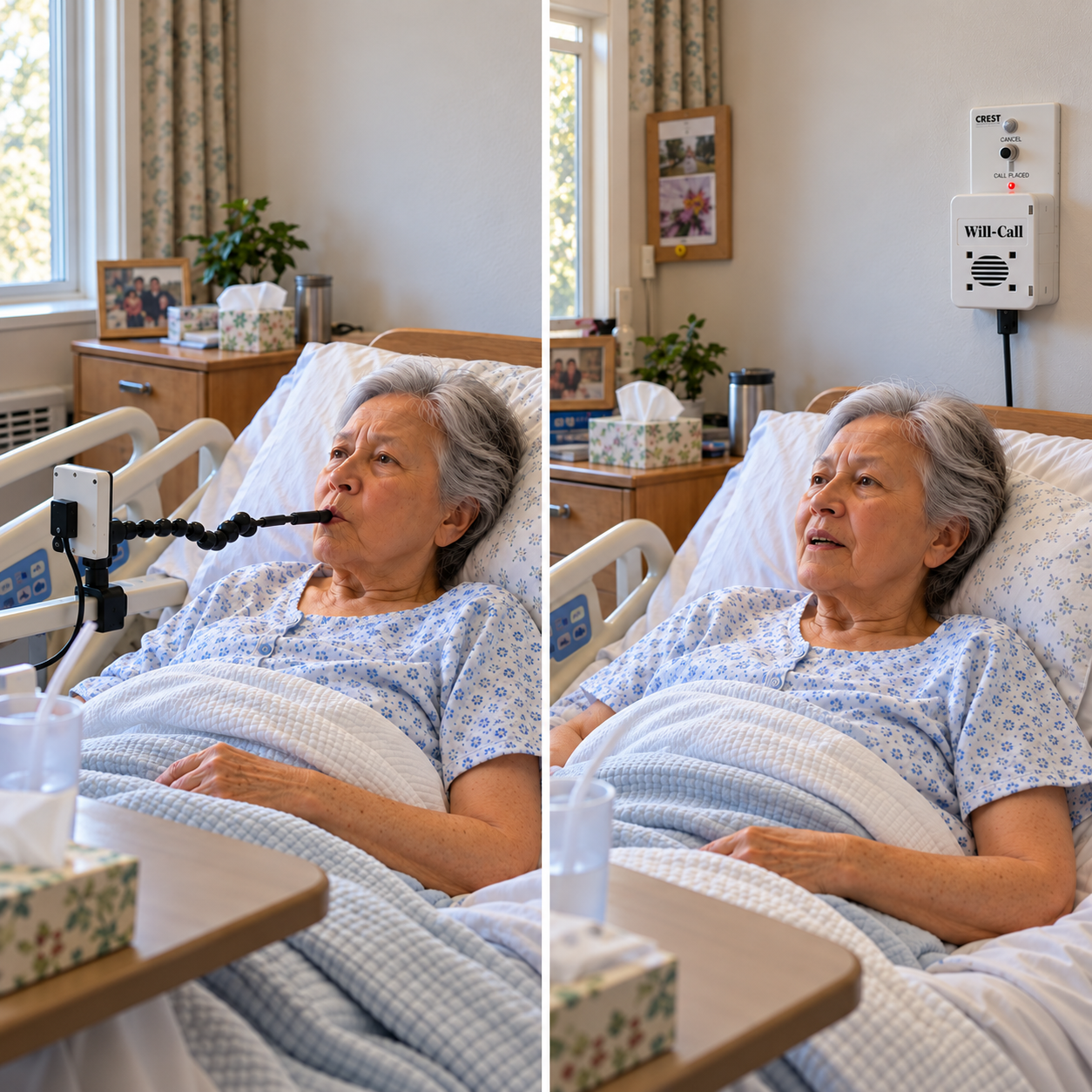
Will-Call is a voice-activated nurse call accessory. A resident says "I need help" and the existing nurse call system in their room activates the same way it would if a button were pressed. It plugs into the existing nurse call jack. It does not require Wi-Fi, an app, or a system replacement.
It may fit when a sip-and-puff reassessment points toward voice for one of these reasons:
- The resident has intact speech and cognition but declining respiratory capacity for controlled breath patterns
- The tube positioning is causing consistent comfort or visual field problems
- The hygiene and maintenance load on staff has become disproportionate to the benefit
- The resident has expressed a preference for an option that does not involve a mouthpiece
- The resident uses an AAC or speech-generating device (eye-gaze, switch-scanning) that can be programmed to speak "I need help" aloud
The AAC case is worth naming specifically. A resident who cannot produce natural speech but uses a speech-generating device can trigger Will-Call by having the device play the activation phrase through its speaker. This has been confirmed in practice at a North Texas skilled nursing facility, where a resident with advanced ALS used her eye-gaze device to activate Will-Call reliably. Losing natural speech does not automatically remove voice-accessible call support as an option, as long as the resident has or could use an AAC device that produces the phrase audibly.
A Canadian long-term care resident's transition from sip-and-puff shows the pattern in practice. After the sip-and-puff was no longer comfortable for daily use, the team transitioned the resident to voice-accessible call support with a simple cable adjustment. The reported result was improved comfort, reliability, and the resident's ability to call for help independently.
If you are working through a reassessment with a specific resident, a Test Drive lets the team evaluate voice-accessible call support in the actual room before committing to a change.
Will-Call is not a universal replacement for sip-and-puff. It also is not appropriate for residents whose speech is unreliable and who do not have or want an AAC device. And for residents with progressive respiratory decline, voice may become less reliable over time in a similar pattern to sip-and-puff, though the specific mechanism differs. Honest fit assessment matters as much for voice as it does for any other access method.
Comparing the options at a glance
| Access method | Best fit | Common limitations | Setup considerations | What to reassess over time |
|---|---|---|---|---|
| Sip-and-puff (current) | Intact respiratory control, tolerates oral device, adequate head/mouth positioning | Calibration drift, tube positioning, hygiene load, single-patient use | Initial calibration, mouthpiece mounting, cleaning schedule | Respiratory capacity, comfort with tube, staff maintenance load |
| Adjusted sip-and-puff | Setup issue is fixable through recalibration or repositioning | Same underlying dependencies as original setup | Sensitivity retuning, mounting hardware review | Whether adjustment holds over weeks |
| Alternate switch site (head, cheek, chin) | Reliable small isolated movement at a non-hand site | Requires precise positioning, secure mounting | OT-guided placement, mounting hardware | Whether target movement stays reliable |
| Voice-accessible call support | Reliable ability to speak the phrase audibly (natural voice or AAC) | Depends on speech reliability; not a fit if speech is inconsistent and no AAC device is in use | Microphone placement, compatibility check with nurse call system | Whether speech or AAC output stays reliable |
What to check before changing a resident's access method
Reassessment is a clinical decision, not a purchasing decision. Before making a change, work through these questions with the team.
- Has an occupational therapist observed the resident using the current setup across different times of day?
- Has the current setup been recalibrated or repositioned before being deemed no longer viable?
- Is there documented agreement from the resident (or their advocate) that the current setup is no longer working?
- Has the alternative being considered been tested in the actual room, not just in concept?
- For voice-accessible options, has the resident demonstrated ability to speak the activation phrase reliably, or has an AAC pathway been confirmed?
- Has the maintenance team confirmed compatibility with the existing nurse call system?
- Is there a plan for what happens during the transition period, when the resident may need both methods available?
- Has the family or advocate been informed and included in the decision?
For any voice-accessible option, how Will-Call plugs into an existing nurse call system covers the technical side of what to check.
FAQ
Is voice easier than sip-and-puff for someone with limited hand function?
Not universally. Voice is easier for residents who have reliable speech and intact cognition and who find the tube-and-mouthpiece setup uncomfortable or hygienically burdensome. Sip-and-puff may still be easier for residents whose speech is unreliable and who have strong respiratory control. The right answer depends on the specific resident, not on the category of device.
Can a resident who cannot speak naturally still use a voice-activated call system?
Yes, in some cases. A resident who uses a speech-generating or AAC device (eye-gaze, switch-scanning) can program the activation phrase into the device. When the device speaks the phrase aloud through its speaker, the voice-activated system detects it the same way it detects natural speech. This has been confirmed in a documented ALS deployment.
Does the sip-and-puff switch still need to stay in the room during a transition?
That is a clinical judgment call. During a transition period, having both methods available lets the team confirm the new setup is reliable across different times of day and different conditions before removing the previous option. Some teams keep the original in place for two to four weeks as a fallback. Others transition more quickly based on the resident's comfort with the new method.
What if the resident's respiratory capacity changes over the day?
Sip-and-puff calibration is fixed at the point it was set. If respiratory capacity varies significantly across the day, the calibration may work in the morning and fail in the evening, or vice versa. This is a common reassessment trigger and often leads to either recalibration to the weaker part of the day, sensitivity adjustments, or a switch to a method that does not depend on breath pressure detection.
Who at the facility should be involved in a reassessment?
At minimum, an occupational therapist familiar with switch assessment, the nursing team who observes the resident daily, and the resident or their advocate. For any change involving the nurse call system connection, maintenance or the nurse call vendor should be consulted on compatibility. For residents with progressive conditions, involving speech-language pathology and respiratory therapy is often useful.
The next step
If you are working with a specific resident whose sip-and-puff setup has stopped feeling like the right fit, the useful next step is a structured reassessment: OT observation across the day, a conversation with the resident and family about what is not working, and a technical check on what alternatives the existing nurse call system can support.
For teams considering voice-accessible call support as one of those alternatives, request a 30-day Test Drive so the team can evaluate fit in the actual room before committing to a change.
Sources
- Curbell Medical, Zephyr Breath-Activated Call Device
- OccupationalTherapy.com — Switch Assessment: Determining Optimal Switch Type and Placement, Michelle Lange, OTR/L, ATP/SMS
- Wikipedia — Sip-and-puff
- USPTO Patent 6,833,786 — Pneumatic demultiplexer for controlling multiple assistive technology devices